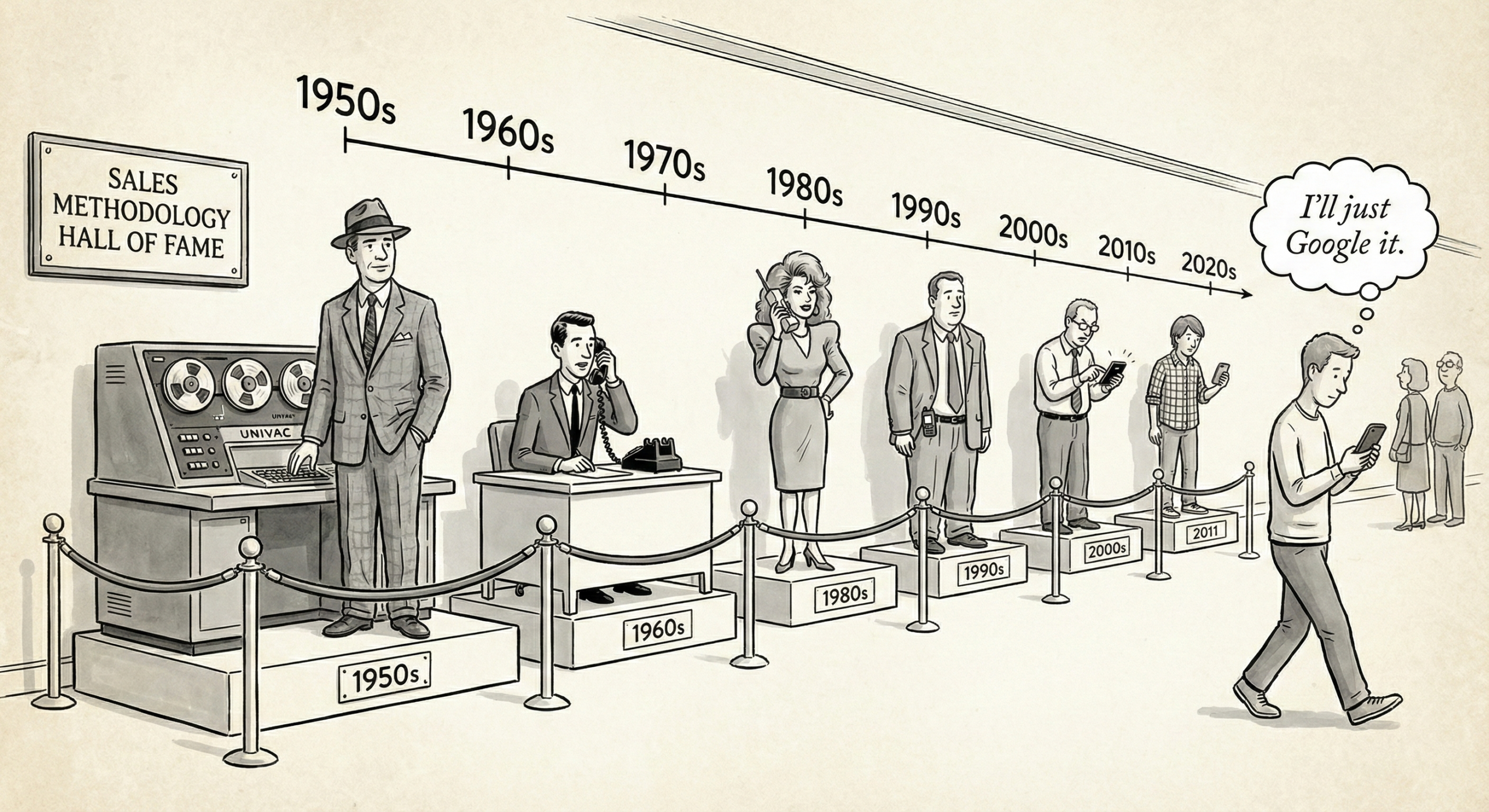
We treat sales methodologies like they’re timeless wisdom carved in stone.
“This is how we’ve always done it.” “It’s battle-tested.” “The fundamentals never change.”
But here’s a fun exercise: look up when your methodology was actually created, and then look up what else was happening in the world that year.
The results are illuminating. And by illuminating, I mean mildly terrifying.
BANT (1950s)
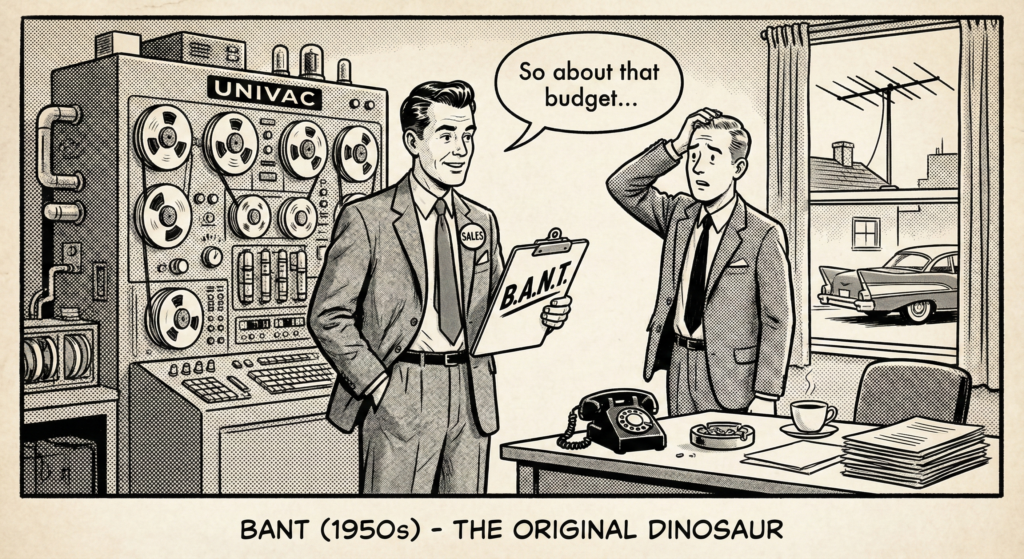
IBM created BANT in the 1950s. Let me paint you a picture of what that world looked like:
Eisenhower was president. The Korean War was either happening or had just ended. Elvis Presley was just getting started. Alaska and Hawaii weren’t even states yet. Television existed in about a third of American homes – and it was black and white. The UNIVAC, one of the first commercial computers, was the size of a room, cost over a million dollars, and could do what your phone’s calculator does now.
The internet? ARPANET was still a decade away. Your prospect’s “research” meant asking around at the country club or waiting for a brochure to arrive by mail. The fax machine hadn’t been invented yet. Color TV was experimental. A “computer” was a person who did math.
BANT was designed when asking about Budget made sense because your prospect had literally no other way to find pricing information. Authority meant finding the one guy who signed checks. And Timeline? Please – everything took months because everything took months.
Yet somehow, this is still the default qualification framework at most companies. The methodology is older than the entire commercial aviation industry’s safety regulations.
The Sandler Selling System (1967)
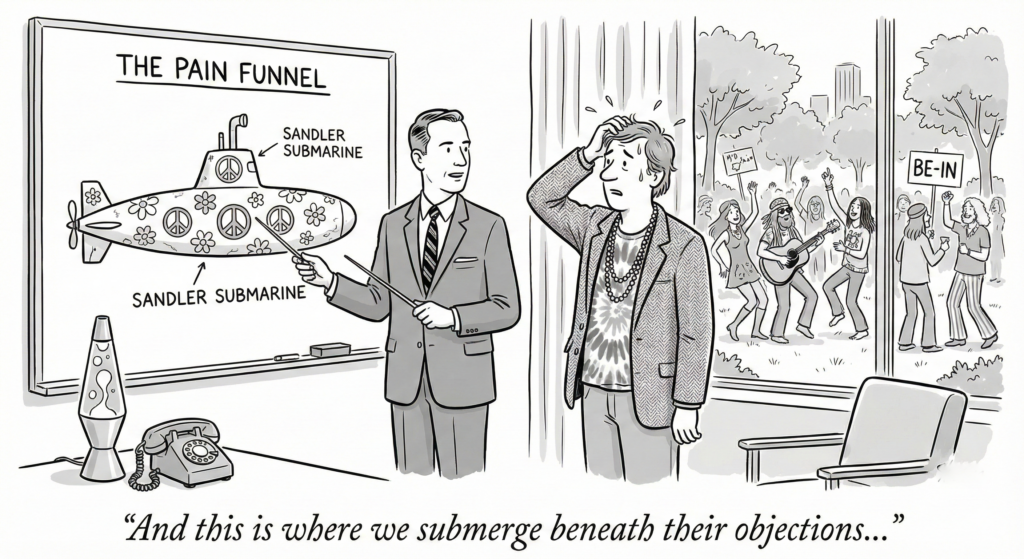
David Sandler founded his system in 1967. That year:
The Summer of Love was happening in San Francisco. The Beatles released Sgt. Pepper’s Lonely Hearts Club Band. The first Super Bowl was played (Packers beat the Chiefs). Thurgood Marshall became the first Black Supreme Court Justice.
There was no internet. ARPANET was still two years away. Calculators cost $400 and were the size of typewriters. Color television was still a novelty. If you wanted to research a company, you went to the library and looked them up in Dun & Bradstreet.
The Pain Funnel was developed when the most advanced pain your prospect experienced was waiting three weeks for a brochure to arrive in the mail.
The Sandler Submarine was designed before submarines had GPS.
Strategic Selling (1985)
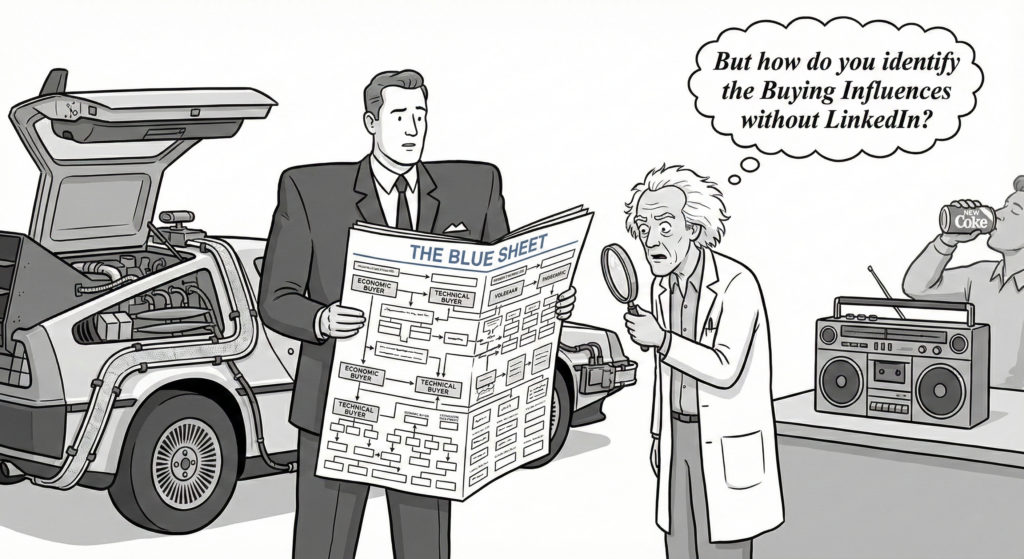
Robert Miller and Stephen Heiman published Strategic Selling in 1985. Context:
Back to the Future was in theaters. New Coke was launched and immediately became one of the biggest marketing disasters in history. The first Blockbuster Video store opened. “We Are the World” was the anthem of the year. Everyone wore shoulder pads.
Cell phones existed, but they weighed two pounds and cost $4,000. The World Wide Web was still four years away. If you wanted to identify the “Buying Influences” in an account, you asked your buddy if he knew anyone at the company.
The Blue Sheet was born in an era when your research on a prospect meant asking your buddy if he knew anyone at the company.
SPIN Selling (1988)
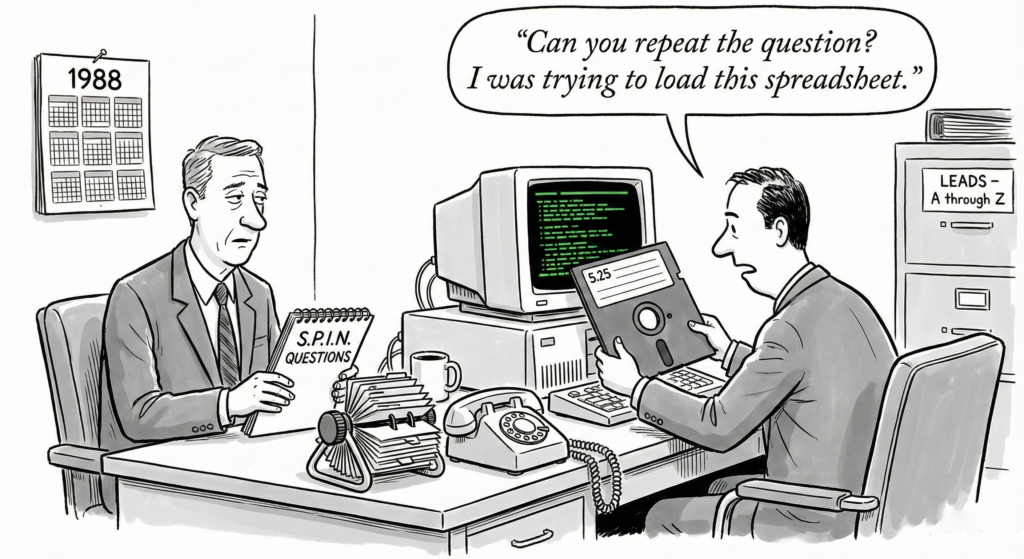
Neil Rackham published SPIN Selling on May 22, 1988, based on 12 years of research and 35,000 sales calls. Here’s what 1988 looked like:
Rain Man won Best Picture. Die Hard made Bruce Willis an action star. The Morris Worm infected 6,000 of the approximately 60,000 computers connected to the internet. That’s not a typo – there were only 60,000 computers online in the entire world.
CDs outsold vinyl for the first time. Nike launched “Just Do It.” A state-of-the-art floppy disk held 1.44 megabytes – not gigabytes, megabytes. Your smartphone’s smallest app is bigger than all the data storage in a 1988 office.
SPIN questions were designed before your prospect could spin up a Google search while you were talking.
Solution Selling (1994)
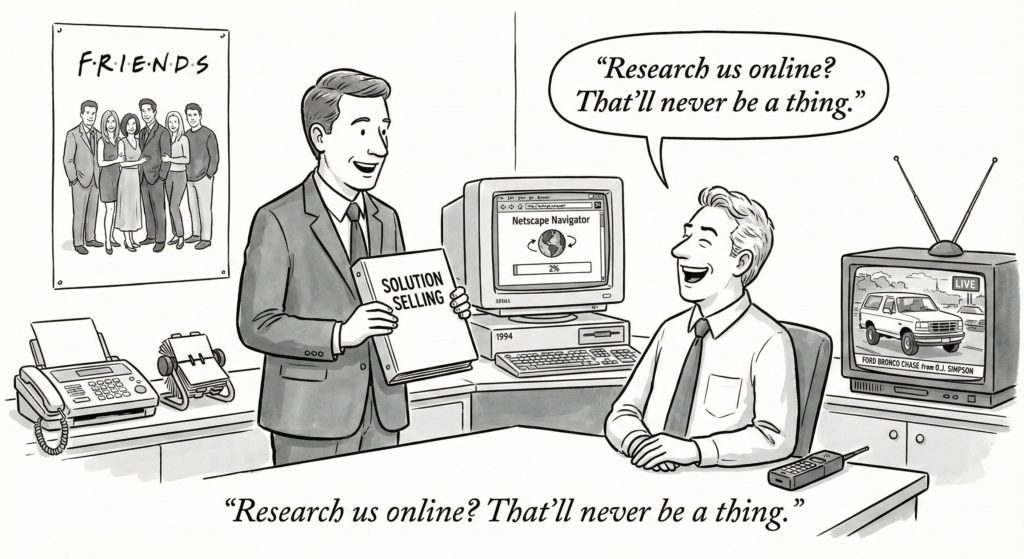
Michael Bosworth published Solution Selling on September 22, 1994. That year:
O.J. Simpson led police on the most famous low-speed chase in history. Friends premiered. Forrest Gump won Best Picture. Amazon was founded – but it only sold books.
There were approximately 2,500 websites in the entire world. Today there are over 1.9 billion. Netscape Navigator had just launched. Google didn’t exist. The White House had just gotten its first website. Your prospect finding information about you online? Virtually impossible.
Solution Selling was built for a world where the buyer’s “research” was calling three vendors and asking for brochures.
MEDDIC (1996)
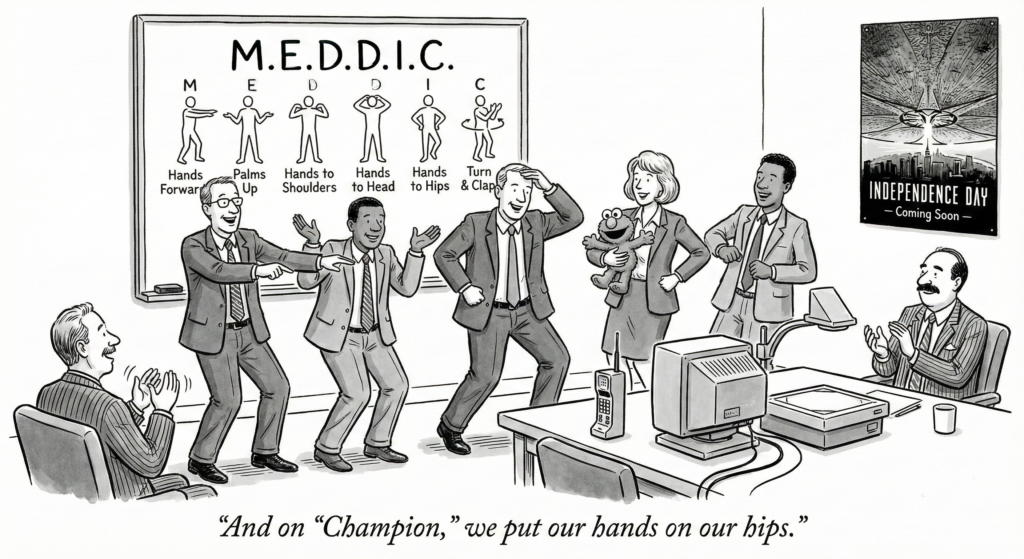
Dick Dunkel developed MEDDIC at PTC (Parametric Technology Corporation) in 1996, working under John McMahon with Jack Napoli. It helped take PTC from $300 million to $1 billion in just four years. Context:
The Macarena was the #1 song. Independence Day made aliens cool again. Dolly the sheep was cloned. Parents were getting into fistfights over Tickle Me Elmo.
Google was still two years away. DVDs had just been introduced. eBay had just launched. If your prospect wanted to understand their competition’s approach, they had to – I don’t know – maybe attend a trade show?
MEDDIC was designed before your prospect’s economic buyer could ask ChatGPT for a competitive analysis.
The Challenger Sale (2011)
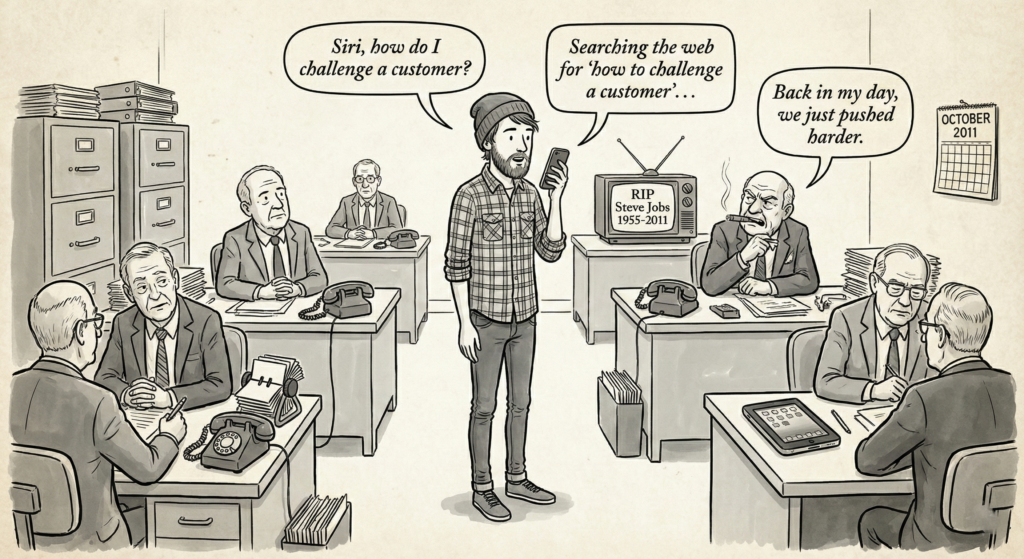
Matthew Dixon and Brent Adamson published The Challenger Sale on November 10, 2011. This one’s more recent, but still:
The iPhone 4S had just launched with Siri – the first mainstream voice assistant. Steve Jobs died that year. Snapchat launched. Instagram was about one year old.
TikTok was five years away. ChatGPT was eleven years away. Zoom was two years away. The statistic that “57% of the buyer’s journey is complete before they contact sales” was new and shocking. Today that number is closer to 70-80%.
The Challenger Sale is the “youngest” major methodology, and it was published before most of your prospects had ever heard of a GPT.
Predictable Revenue (2011)
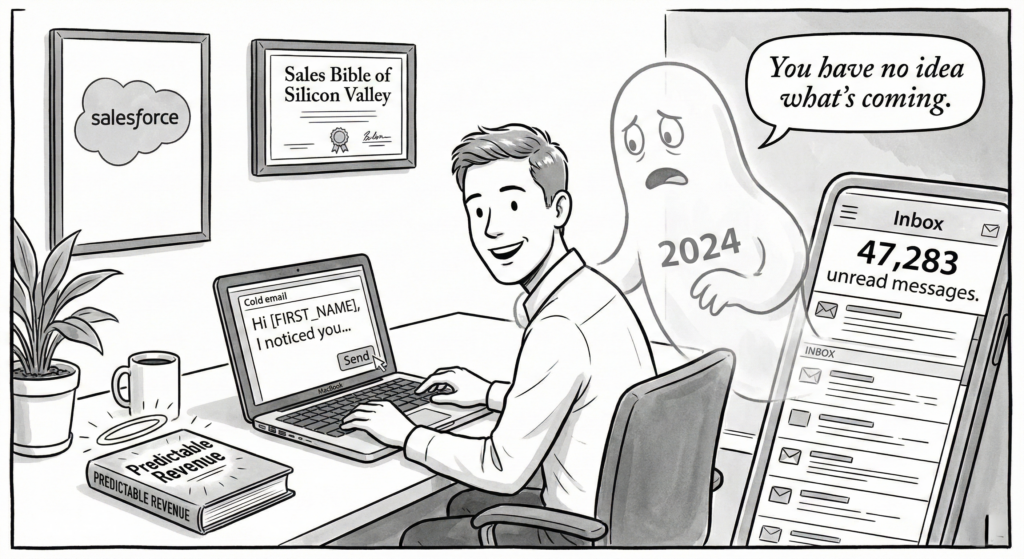
Aaron Ross and Marylou Tyler published Predictable Revenue in 2011 – the same year as The Challenger Sale. It became known as “The Sales Bible of Silicon Valley” and created the modern SDR (Sales Development Representative) model that every SaaS company copied.
Here’s what’s interesting: even Aaron Ross himself has acknowledged that the game has changed and his methodology is no longer as relevant as it once was.
Think about that. The guy who wrote the book – the book that launched a thousand SDR teams – is basically saying “yeah, that was then.”
In 2011, “Cold Calling 2.0” meant sending short emails to executives asking for referrals. Today, those same executives receive hundreds of those emails per week. The inbox has become the new cold call – and it’s just as dead.
Predictable Revenue was designed before AI could generate thousands of “personalized” emails per hour, making every inbox a war zone.
See the Pattern?
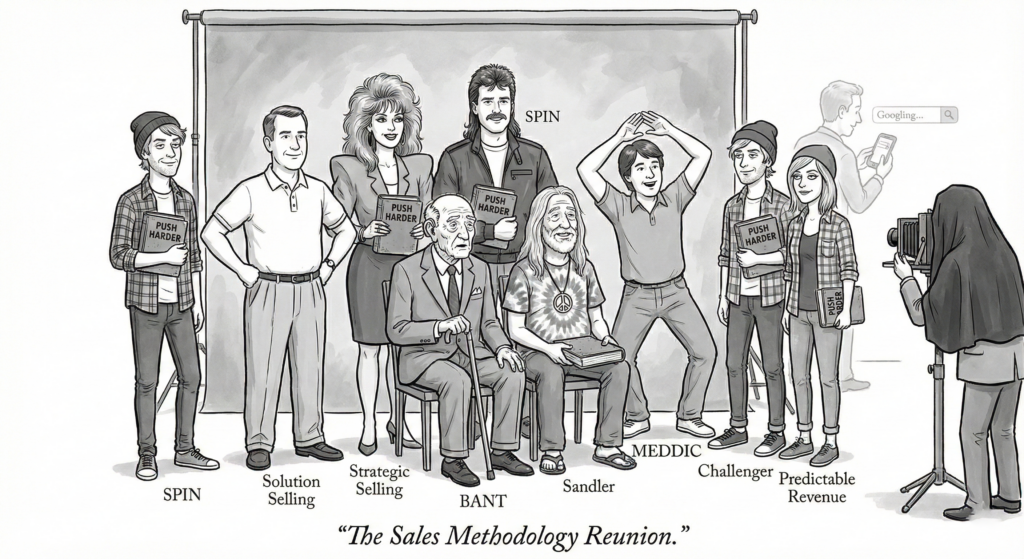
Every single one of these methodologies was designed for a world where the seller controlled information. Where the buyer had to talk to you to learn anything about your product, your pricing, your competitors, or your approach.
That world doesn’t exist anymore.
Your prospect can now:
Read every review of your product on G2 and Capterra. Watch video demos without talking to anyone. Calculate ROI using online calculators. Ask ChatGPT to compare you to your competitors. Find your pricing on Reddit. Connect with your current customers on LinkedIn and ask what they really think.
The world has changed more in the last 10 years than it did in the previous 50. But somehow, we’re still using sales playbooks from the era of the Macarena. Or shoulder pads. Or, God help us, Eisenhower.
The Point
I’m not saying these methodologies are worthless. They contain real insights about human psychology and complex buying decisions. SPIN’s focus on implications is brilliant. Sandler’s understanding of buyer psychology is profound. MEDDIC’s rigor around qualification is valuable.
But we need to stop pretending they’re timeless. We need to stop treating them like sacred texts that can’t be questioned.
The buyer has changed. The information landscape has changed. The power dynamic has completely inverted.
Maybe it’s time to think about selling in the world that actually exists. Not the world of “We Are the World.” Not the world of the Macarena. And definitely not the world of Eisenhower.
The question isn’t whether these methodologies worked. It’s whether they work now.
This Post Hit a Nerve?
Join the waitlist if you've been asking similar questions. Or if this made you start asking them.
Instant access. No spam. Unsubscribe anytime.