The Uncomfortable Question
Here’s a question I’ve been wrestling with:
Why do some people with undeniable track records suddenly seem to stall?
Not people who got lucky once. People who’ve done it repeatedly. Who’ve built things from nothing to something. Who’ve turned around failing situations. Who’ve proven, over and over, that they know how to generate results.
And then they land somewhere and… it doesn’t click. The magic isn’t there. The scoreboard doesn’t reflect what they’ve shown they’re capable of.
The easy explanation is that they’ve lost it. That past success was luck or timing. That they’re coasting on reputation.
But there’s another explanation. One that’s harder to see from the outside.
The Difference Between Can’t and Won’t
There’s a massive difference between someone who can’t perform and someone who can’t fully commit to a system they don’t believe in.
The first is a capability problem. The second is an alignment problem.
They look identical from the outside. The results are similar. But the root cause is completely different.
When you’ve spent decades learning what actually works – when you’ve seen it work, repeatedly, in your own hands – being asked to execute a playbook you know is flawed creates a kind of cognitive dissonance that’s hard to overcome.
Your body is in the room. Your hands are doing the work. But your heart isn’t in it. Because every instinct you’ve developed is screaming that this approach is wrong.
The Construction Worker vs. The Architect
Some people are great at executing within a system someone else designed.
Some people are great at seeing what’s broken and designing something better.
These are different skills. And here’s what most people miss: the best architects are often excellent construction workers too. They’ve done the work. They know what execution looks like. That’s how they developed the ability to see what works and what doesn’t.
But once you’ve seen enough – once you understand the physics of why certain approaches fail – it becomes nearly impossible to execute with full conviction inside a flawed system.
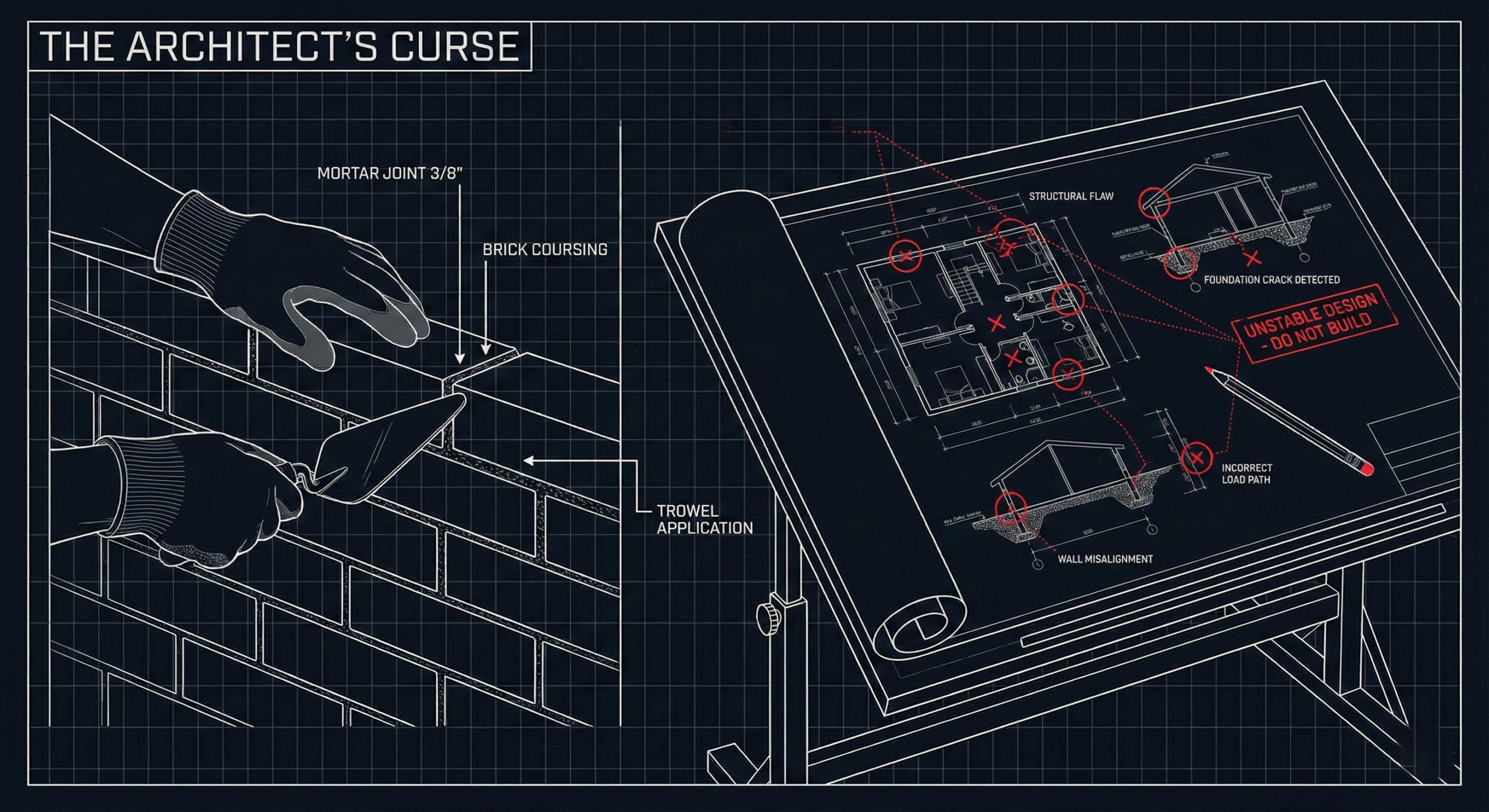
The construction worker looks at blueprints and builds exactly what’s specified. Their excellence is measured by precision and consistency.
The architect looks at the same blueprints and sees the flaws – the load-bearing wall in the wrong place, the traffic flow that doesn’t work, the foundation that won’t hold.
Put an architect on a construction crew building from bad blueprints and they’ll spend all day frustrated by decisions they had no part in making. Not because they can’t lay bricks. Because they know the wall they’re building is going to fail.
The Pattern Is Everywhere
Bill Belichick – mediocre player, greatest coach of his era. He could execute. But his genius was seeing what elite execution required and building systems to produce it at scale.
Phil Jackson – average NBA career, 11 championships as coach. He’d been in the arena. He knew what playing looked like. His gift was seeing how pieces fit together in ways the pieces themselves couldn’t see.
The best sales leaders I’ve known weren’t always the top individual performers. But they’d all performed. They’d carried a bag. They’d made the calls. They’d closed the deals. And then they developed the ability to see the patterns underneath.
The people who SEE systems aren’t always the ones who thrive INSIDE them. Especially when those systems are broken.
I Know This Because I’m Living It
I’m not writing this from theory. I’m writing it from the middle of the experience.
I’ve performed. I took a dying agency from almost nothing to $100 million in four years – during a recession. I scaled a fitness retailer from $5 million to $75 million. I built a $40 million account from the ashes of a relationship everyone told me to abandon. I’ve made 53,000 cold calls. I’ve been in the arena for three decades.
So when I say I know what works, I’m not speculating. I’ve done it. Repeatedly.
But right now? Right now I see colleagues running a traditional sales playbook – the exact approach I’ve spent years understanding why it fails. I watch the forecast calls and see the preventable mistakes. I sit through the pipeline reviews and recognize the patterns. I know what’s coming before it happens because I’ve seen it a hundred times.
And my heart isn’t fully in it. Not because I’ve lost the ability. Because I’m being asked to build from blueprints I don’t believe in.
The skeptic might say: “If he’s so good, why isn’t he crushing it where he works?”
The answer: “Because they run traditional sales. I’m building the methodology that explains why traditional sales is broken.”
I can lay bricks. I’ve proven that. But I can’t lay them with full conviction when I know the wall is going to fall.
Two Different Scorecards
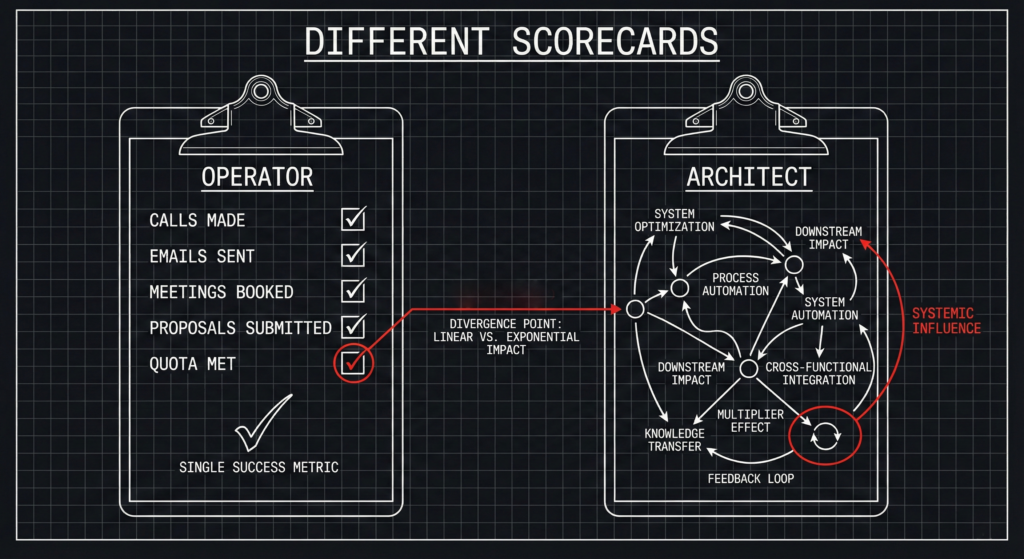
The construction worker’s success is measured by how well they execute the blueprint they’re given.
The architect’s success is measured by how well the blueprint works for everyone who builds from it.
These aren’t the same scorecard. And when you start measuring an architect by construction metrics while forcing them to build from bad blueprints, the numbers will look like underperformance.
But the real question isn’t whether they can swing a hammer. It’s whether the building they’re being asked to build should exist at all.
The Uncomfortable Truth
If you’re reading this and nodding – if you’ve got a track record but find yourself stalling inside a system you don’t believe in – you might be an architect stuck in a construction role.
That doesn’t mean you’ve lost it.
It means you’re in the wrong job. Or the wrong system. Or both.
The question isn’t whether you can execute. You’ve already proven that. The question is whether you can execute with full conviction inside something you know is flawed.
Some of us are meant to build from blueprints. Some of us are meant to draw them.
And some of us have done both – which is exactly why we can’t go back to building from blueprints we know are wrong.
The System Wasn't Built for This Buyer.
Your prospects complete 70% of their journey before they talk to you. Your playbook assumes they're waiting by the phone.
Instant access. No spam. Unsubscribe anytime.