I’ve been carrying this question around for years. It started as a whisper during deal reviews and became a shout that I couldn’t ignore. The question is simple. The implications are not.
Why does an entire profession – a profession built on understanding what makes people say “yes” – almost completely ignore the most validated finding in the history of behavioral economics?
The Research That Won a Nobel Prize
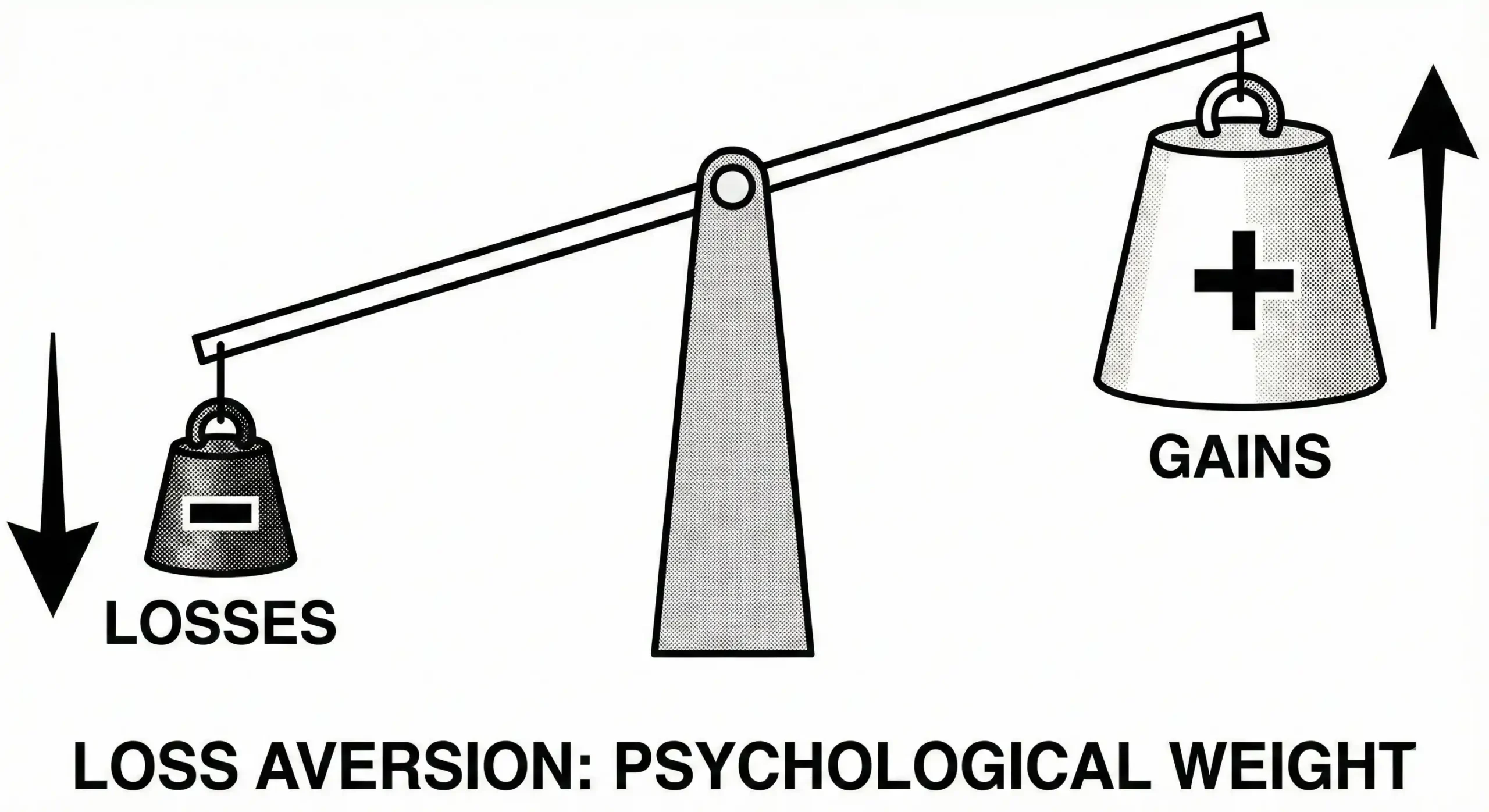
In 1979, psychologists Daniel Kahneman and Amos Tversky published a paper called “Prospect Theory: An Analysis of Decision Under Risk.” It would become one of the most cited papers in the history of economics and eventually win Kahneman the Nobel Prize. The core finding was deceptively simple: losses hurt more than equivalent gains feel good.
Not a little more. Roughly twice as much.
The experiments were elegant. Give someone $100, then offer a coin flip: heads they win another $100, tails they lose the original $100. Mathematically neutral. Psychologically devastating. Most people refuse. The potential loss of $100 looms larger than the potential gain of $100, even though the amounts are identical. As decades of subsequent research has confirmed, humans experience losses with roughly 2 to 2.5 times the psychological intensity of equivalent gains.
This isn’t a quirk. It’s not a bug. It’s how human brains evolved to function. Avoiding threats was more important for survival than capturing opportunities. The ancestors who felt losses acutely lived to reproduce. The ones who didn’t became lunch.
Fifty years of research. Thousands of studies. A Nobel Prize. Complete consensus in the scientific community. Loss aversion is as close to a law of human behavior as psychology has ever produced.
What Sales Does Instead
Now look at how sales actually operates.
Every pitch deck leads with benefits. Every demo emphasizes features. Every business case calculates ROI – Return on Investment. Gain, gain, gain. “Here’s what you’ll get. Here’s what you’ll achieve. Here’s the upside.”
We build elaborate models showing 3x returns and 18-month payback periods. We create case studies celebrating what customers gained. We train reps to articulate value propositions – propositions about value to be added, not value being lost.
The entire machinery of modern sales is built on the assumption that gains motivate action.
The research says the opposite. The research says losses motivate action at twice the intensity. And we ignore it. Systematically. Industry-wide. Decade after decade.
The Question That Wouldn’t Leave

I first encountered loss aversion research maybe fifteen years ago. Read it, understood it, filed it away as interesting. Then I watched it play out in deal after deal – without recognizing what I was seeing.
The deals that closed fast were always the ones where the buyer was running from something. Not toward something – from something. A failing system. A contract renewal with a vendor they hated. A competitor gaining ground. A board breathing down their neck. A career at risk.
The deals that stalled forever were the ones built on aspiration. “We could be more efficient.” “We’d like to improve.” “There’s potential upside.” Nice-to-haves dressed up in business cases. ROI projections that nobody felt in their gut.
For years, I attributed this to urgency. The fast deals had urgency; the slow ones didn’t. True enough. But that’s describing the symptom, not the cause. Why did some deals have urgency? Why did others drag on despite “compelling” business cases?
Loss aversion. It was right there in the research I’d read and forgotten. The fast deals had loss at their core. The slow deals had gain at their core. And gain, no matter how large, never creates the urgency that loss does.
The Industry’s Blind Spot
Once I saw this, I couldn’t unsee it. And I started asking why.
Why does SPIN Selling teach “Implication Questions” without ever mentioning loss aversion – the psychological mechanism that makes implication questions work?
Why does Challenger talk about “teaching for differentiation” but frame commercial insight around gains rather than costs?
Why do we train reps to calculate ROI when we should be training them to calculate the cost of inaction?
Why does every sales methodology treat Kahneman’s Nobel Prize-winning research as a footnote at best, an afterthought at worst?
I don’t have complete answers. Maybe it’s because “look what you could gain” feels more positive than “look what you’re losing.” Maybe it’s because marketing departments prefer aspirational messaging. Maybe it’s because nobody wants to be the salesperson talking about pain and loss and failure.
Or maybe – and this is the uncomfortable possibility – maybe the sales industry has never seriously engaged with behavioral science at all. Maybe we’ve been running on intuition and tradition, optimizing tactics without understanding the psychology beneath them.
An Experiment in Plain Sight
Here’s what kept me up at night. If loss aversion is real – and it is – then the entire industry is running a suboptimal strategy. Not slightly suboptimal. Dramatically suboptimal. We’re leading with messages that land with half the psychological force of the alternative.
Every ROI calculation could be reframed as a cost calculation. Every benefit statement could be restated as a loss prevention statement. Every “here’s what you’ll gain” could become “here’s what you’re currently losing.”
Same facts. Same deal. Twice the psychological impact.
This isn’t speculation. This is what the research predicts. And yet the experiment – applying loss aversion systematically to sales methodology – remains largely unrun. We have fifty years of behavioral science and an industry that acts like it was never published.
Why I’m Writing This
This question – why don’t we use loss aversion? – became the thread I couldn’t stop pulling. And the more I pulled, the more unraveled. Loss aversion connected to reactance theory, which connected to status dynamics, which connected to the fundamental relationship between pressure and resistance.
What started as a question about one overlooked study became a question about the entire foundation of sales methodology. If we got loss aversion wrong, what else did we get wrong? If the research has been sitting there for fifty years, what other findings are we ignoring?
I don’t have all the answers yet. I’m not pretending I do. But I have the questions – and I’m convinced they’re the right questions. Questions the industry should have been asking decades ago.
That’s why I’m writing a book. Not to present a polished system, but to work through what happens when you take behavioral science seriously. When you rebuild methodology from first principles. When you stop treating Nobel Prize-winning research as optional reading.
You Were Trained to Fail.
Every methodology, every manager, every metric. The System was built for a buyer who no longer exists.
Instant access. No spam. Unsubscribe anytime.