Six months ago, I started writing a book. I thought I knew what I was writing about. I had twenty years of experience. I had observations. I had patterns I’d seen repeat across hundreds of deals. How hard could it be to put it on paper?
I was an idiot.
Not because the writing is hard – though it is. Because every time I try to articulate something I thought I understood, I discover I don’t understand it at all. Every answer I find cracks open three more questions. What started as a book about sales methodology has become an excavation of assumptions I didn’t know I was making.
What I Thought I Was Writing
The original idea was straightforward. I’d seen enough deals to know that conventional wisdom was wrong. The playbooks weren’t working. The methodologies were outdated. Someone needed to write the updated version.
I figured I’d document what I’d observed, structure it into a framework, and ship it. Twelve months, maybe eighteen. A nice tight package of “here’s what’s broken and here’s how to fix it.”
That’s not what’s happening.
The Threads That Won’t Stop
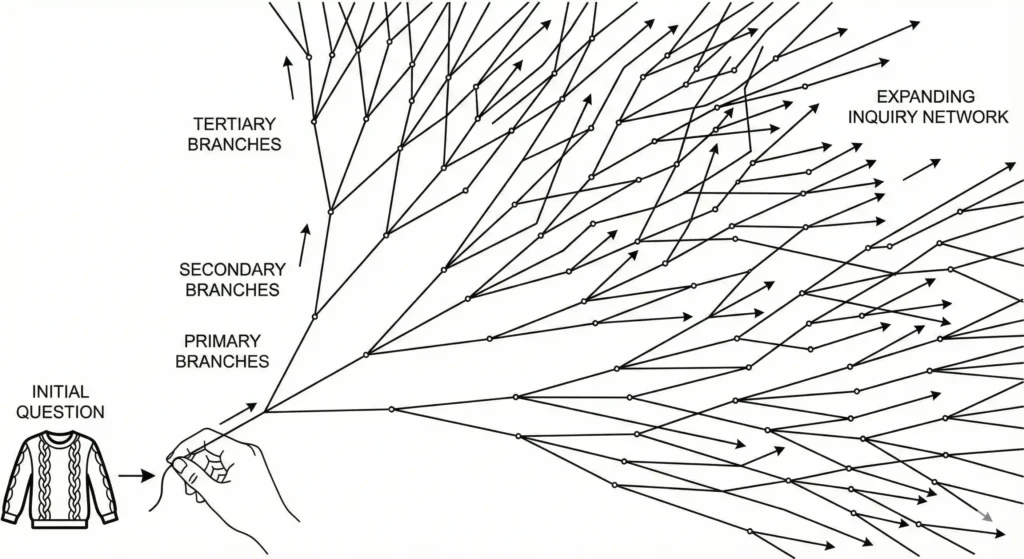
It started with a simple question: why do deals stall? I thought I knew – weak champions, unclear timelines, lack of urgency. Standard stuff. But when I tried to write about it, I kept asking “why” one more time. Why do buyers lose urgency? Why do champions go weak? What’s actually happening in the buyer’s head when a deal dies?
That led me to behavioral psychology. Loss aversion. Reactance theory. Status dynamics. Cognitive dissonance. Research I’d vaguely heard of but never seriously studied.
And here’s what I found: the science exists. When Daniel Kahneman won the Nobel Prize in Economics in 2002, it validated decades of research on how humans actually make decisions. Loss aversion. Cognitive bias. The gap between how we think we decide and how we actually decide. But almost none of it has been seriously integrated into sales methodology. We’re running on intuition and tradition while an entire field of Nobel Prize-winning science sits ignored.
Why? That’s another question I can’t fully answer yet.
Then I pulled another thread: if the psychology works the way the research says it does, then why are we doing the opposite? Why does every sales training teach techniques that trigger the exact psychological responses we don’t want? Is it ignorance? Inertia? Or is there something structural – something about how sales organizations are built – that perpetuates approaches that don’t work?
More questions. Fewer answers.
The Uncomfortable Realization
Here’s what I’ve come to accept: I’m not writing a book about tactics. I’m trying to understand a system. And systems are complicated.
The more I dig, the more I see how interconnected everything is. The CRM isn’t just a tool – it encodes assumptions about how deals progress. The comp plan isn’t just incentives – it shapes behavior in ways that might undermine the very outcomes it’s trying to drive. The training isn’t just education – it’s indoctrination into a worldview that may no longer be valid.
I thought I was writing about seller behavior. Now I’m questioning the entire architecture that produces seller behavior.
That’s a much bigger project than I signed up for.
What I Don’t Know
I’m going to be honest about where I am, because I think intellectual honesty matters more than false confidence.
I don’t know if the patterns I’ve observed are universal or specific to certain industries, deal sizes, or buyer types. I have hypotheses. I don’t have proof.
I don’t know if the behavioral science translates cleanly into methodology. The research was done in controlled environments. Sales conversations are messy. The gap between laboratory findings and real-world application is real, and I haven’t fully bridged it.
I don’t know if what I’m building will actually work better than what exists. I believe it will. I’ve seen glimpses that suggest it will. But I haven’t run the controlled experiments that would let me claim it definitively.
I don’t know how long this is going to take. The scope keeps expanding. Every chapter I think is finished turns out to need another rewrite once I learn something new.
What I’m Starting to Believe
Despite the uncertainty – or maybe because of it – a few convictions are solidifying.
I believe the current model is fundamentally broken, not just outdated. The fix isn’t incremental improvement. It’s architectural change.
I believe the behavioral science is real and under-applied. The gap between what we know about human decision-making and what we do in sales conversations is massive and costly.
I believe the answer – if there is one – lies in inverting assumptions. Not optimizing the current approach, but questioning whether the approach itself is pointed in the wrong direction.
But beliefs aren’t proof. And I’m not going to pretend I have more certainty than I do.
Why I’m Sharing This
Most people who write books wait until they have answers. They present polished frameworks. Confident assertions. “Here’s what I discovered and here’s exactly how to implement it.”
I’m choosing a different path. I’m sharing the questions while I’m still living in them. Not because I have something to sell – I don’t, not yet – but because I suspect I’m not the only one asking these questions.
If you’re a sales leader watching your playbook fail and wondering why, you’re asking the same questions. If you’re a rep doing everything “right” and still losing deals, you’re asking the same questions. If you’ve read the methodologies, implemented the training, deployed the technology, and still can’t fix your forecast accuracy – same questions.
I don’t have your answers yet. But I’m deep in the work of finding them. And if you want to follow that journey – including the dead ends, the revisions, and the uncomfortable realizations – I’ll keep sharing it here.
You're Not Broken. The System Is.
Stop blaming yourself for results the methodology was designed to produce.
Instant access. No spam. Unsubscribe anytime.