There’s a belief in B2B sales that enterprise buyers are rational actors. That with enough data, enough ROI calculations, enough logic, you can move them to a decision.
A neuroscientist named Antonio Damasio proved this is wrong.
His research on patients with brain damage fundamentally changed how we understand decision-making. And it has profound implications for how we sell.
The Patient Who Couldn’t Decide
Damasio studied patients who had damage to the ventromedial prefrontal cortex – a brain region involved in processing emotion. These patients retained their intelligence, their memory, their analytical abilities. By every cognitive measure, they were still smart.
But they couldn’t make decisions.
One famous patient, known as “Elliot,” could analyze options endlessly. Given a choice between two appointment times, he would list the pros and cons of each, consider the weather, traffic patterns, other commitments – and never choose. Simple decisions that should take seconds became impossible.
What these patients lost wasn’t intelligence. They lost the ability to feel. And without feeling, decision-making collapsed.
The Somatic Marker Hypothesis
Damasio’s explanation is called the Somatic Marker Hypothesis. Here’s the simplified version:
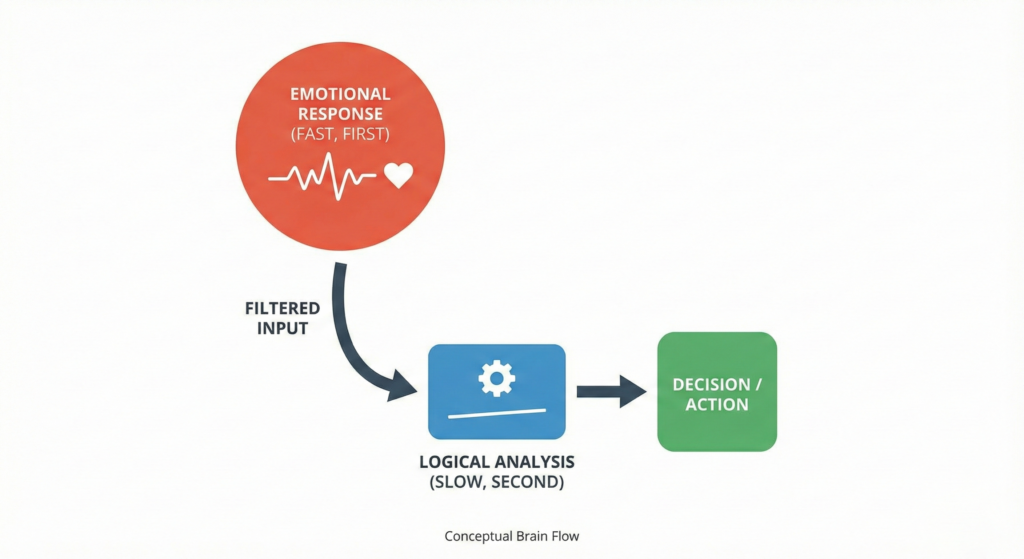
When we face a decision, our brain doesn’t just analyze options logically. It also generates emotional responses – “somatic markers” – that tag certain options as good or bad, safe or dangerous, attractive or repulsive.
These emotional tags act as a rapid filtering system. Before conscious analysis kicks in, emotion has already narrowed the field. “This option feels right. That one feels wrong.”
Without these emotional markers, you’re left with pure analysis. And pure analysis is paralyzing. There are always more factors to consider, more angles to evaluate. Emotion is what allows us to stop analyzing and actually choose.
Damasio’s famous line: “We are not thinking machines that feel. We are feeling machines that think.”
What This Means for Selling
If Damasio is right – and the neuroscience strongly supports him – then the “rational buyer” doesn’t exist.
Even the most analytical CFO, the most data-driven procurement team, the most methodical evaluation process – all of them are being guided by emotion underneath. The spreadsheets and scorecards are important. But they’re not sufficient. They’re how buyers justify decisions. Not how they make them.
Think about what you’re really competing against in every deal:
Fear. Fear of making a bad decision. Fear of championing something that fails. Fear of looking foolish to peers or bosses. Fear of change itself.
Safety. The emotional pull toward the status quo, toward vendors that feel “safe,” toward decisions that won’t get you fired.
Trust. The gut feeling about whether you’re credible, whether you’re telling the truth, whether you’ll be there when things go wrong.
These are emotional states. And they’re operating alongside – often underneath – the rational evaluation your buyer is performing.
The Post-Hoc Rationalization
Here’s something else Damasio’s work suggests: people make decisions emotionally and then rationalize them logically.
The gut feeling comes first. The spreadsheet analysis comes second – to justify what the gut already decided.
This explains why you can “win” every logical argument and still lose the deal. The buyer’s logical brain is saying “your ROI is better.” But their emotional brain has tagged your solution as risky, or tagged you as untrustworthy, or tagged the whole initiative as dangerous.
The logical brain will find reasons to support the emotional conclusion. “The implementation timeline is too aggressive.” “We need more references in our industry.” “Let’s revisit this next quarter.”
These aren’t the real reasons. They’re the rationalized reasons. The real reason is a feeling you never addressed.

Selling to the Feeling Machine
I’ve been thinking about what this means for how I sell.
First: I need to address emotion, not just logic. What is the buyer afraid of? What would make them feel safe? What would need to be true for this decision to feel right, not just analyze right?
Second: I need to help them feel the problem, not just understand it. Data about the cost of inaction is good. But getting them to emotionally connect with that cost – to feel the frustration, the risk, the potential loss – is what creates movement.
Third: I need to watch for emotional signals, not just logical objections. When a buyer’s energy shifts, when they lean back, when something changes in their tone – that’s information. Their emotional brain is reacting to something, even if their logical brain hasn’t verbalized it yet.
Damasio’s work suggests that emotion isn’t a distraction from good decision-making. It’s the foundation of it. Ignore it at your peril.
The Descartes Error
Damasio titled his most famous book “Descartes’ Error” – a reference to the philosopher who declared “I think, therefore I am” and helped establish the Western tradition of separating reason from emotion.
Descartes was wrong, Damasio argues. Thinking and feeling aren’t separate. They’re intertwined. Reason without emotion is impotent.
Sales has made the same error. We’ve built methodologies around logic – features, benefits, ROI, competitive comparisons. We’ve treated emotion as something to overcome or ignore.
But you can’t logic someone into a decision their emotional brain has rejected. And you don’t need to logic someone into a decision their emotional brain has already made.
The buyer is a feeling machine that thinks. Sell to the whole machine.
The Old Way Is Dead.
57% miss quota. 40-60% lost to "no decision." The System is broken. This is the fix.
Instant access. No spam. Unsubscribe anytime.