Last month, a rep on a team I advise asked if I’d review a deal he’d lost. Not a borderline deal – a deal he was certain he’d win. A deal where, in his words, “I did everything right.”
He had. That was the problem.
The Setup
Scott- not his real name – is 26 years old, two years into his sales career, and hungry in all the ways you want a young rep to be hungry. He’d come up through a rigorous SDR program at a well-known SaaS company. He’d been trained by people who knew what they were doing. He had the methodology down cold.
The opportunity was a mid-market software company evaluating solutions in his space. Three vendors in the final round. Scott had built what looked like a strong champion in the Director of Operations. He’d run a tight discovery process. He’d delivered a demo that showcased every relevant feature. He’d sent a proposal with a compelling ROI analysis.
The company chose a competitor with half the functionality and a higher price point.
Scott was stunned. His manager was confused. The loss made no sense on paper.
The Replay

I asked Scott to walk me through the deal from the first touch. Not the CRM notes – the actual conversations. What did he say? What did they say? What was the energy in the room?
The pattern emerged within minutes.
In his discovery call, Scott had asked good questions – the questions he’d been trained to ask. Problem questions. Impact questions. Questions designed to surface pain. But when the prospect answered, Scott didn’t explore. He validated. “That makes sense.” “I hear that a lot.” “We can definitely help with that.” Then he moved to the next question on his list.
The prospect never went deep on anything. Never sat in the discomfort of their own problem. Never articulated – in their own words, at length – what the situation was actually costing them.
In the demo, Scott was flawless. Smooth transitions. Perfect feature-to-need mapping. Every capability tied back to something the prospect had mentioned. He’d clearly practiced. He’d clearly prepared. He talked for probably 80% of the call.
The prospect watched. Nodded. Asked a few clarifying questions. Said it looked great.
Then went dark for two weeks before choosing someone else.
What the Data Shows
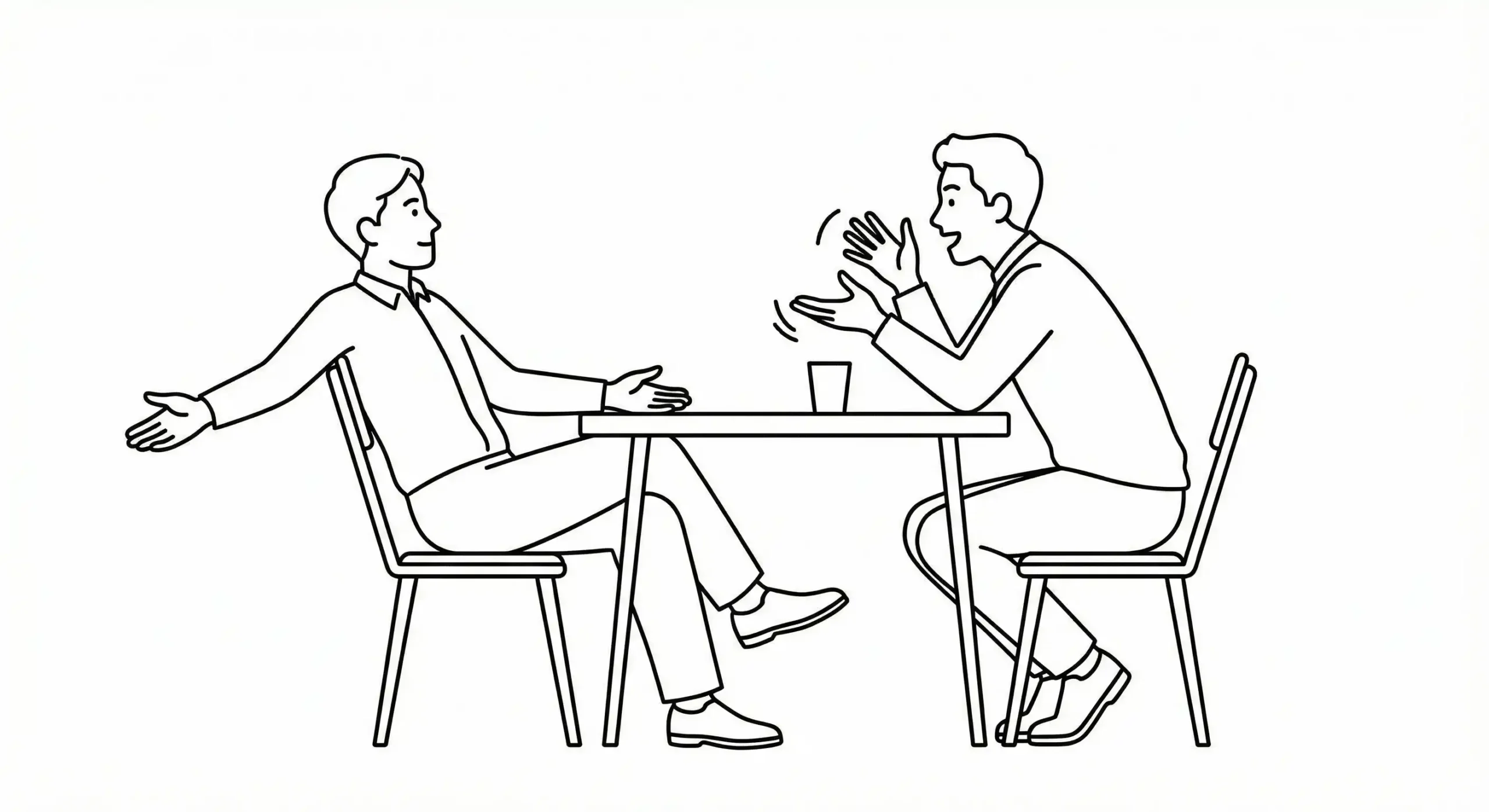
Scott’s experience isn’t unique. Gong’s analysis of millions of sales calls reveals a pattern that should concern every sales leader: the more a seller talks, the less likely they are to win. Top performers maintain a talk ratio around 43%. Average performers talk 60% or more. Losing deals trend toward 65-70% seller talk time.
Scott was performing. He was showcasing. He was demonstrating mastery of his product and his pitch. And every minute he spent talking was a minute the buyer spent disengaged from their own problem.
The competitor who won? I don’t know exactly what they did. But I’d bet they talked less. Asked more. Let the buyer own the conversation about their own pain.
The Training Gap
Here’s what struck me about Scott’s situation: he wasn’t undertrained. He was trained exactly the way most companies train their reps.
He had a discovery framework with specific questions to ask. He had a demo methodology with a prescribed structure. He had talk tracks for objection handling. He had ROI templates for business cases. He had been taught, extensively, what to say.
Nobody had taught him when to stop saying it.
Nobody had taught him that a discovery question is worthless if you don’t let the silence stretch while the buyer thinks. That a demo can be technically perfect and emotionally empty. That nodding along is not the same as buying in.
The training taught him to perform. It didn’t teach him to listen for what wasn’t being said. It didn’t teach him to notice when a buyer was observing instead of engaging. It didn’t teach him that “this looks great” is often the kiss of death.
The Pattern
I see this constantly. Not because reps are bad, but because the system produces it.
The training emphasizes what the seller should do. The metrics track seller activity. The coaching focuses on seller performance. The entire apparatus is seller-centric – and it produces sellers who are highly skilled at talking to buyers rather than engaging with buyers.
Scott ran a textbook sales process. He followed the methodology. He hit the stages. He checked the boxes. And the buyer sat through it politely, never once taking ownership of their own decision.
When the decision came, they chose the vendor they felt most connected to – not the one who performed the best demo. And Scott, who had done everything right, was left wondering what went wrong.
The Observation
I’m not going to pretend I told Scott exactly how to fix this. That’s not what this post is about. What I can share is the observation – the pattern that keeps showing up in deal after deal, team after team.
Perfecting the pitch isn’t the path to winning. It might actually be the obstacle. The deals that close don’t look like performances. They look like conversations. They look like buyers talking themselves into decisions while sellers mostly listen.
I don’t know exactly what the alternative methodology looks like. I’m still working through that. But I know it starts with questioning whether “perfect” is even the right goal.
This Post Hit a Nerve?
Join the waitlist if you've been asking similar questions. Or if this made you start asking them.
Instant access. No spam. Unsubscribe anytime.