Every sales deck has them. The logo slide. The customer quotes. The case study with impressive numbers. “Company X achieved 340% ROI in six months.” “We couldn’t imagine going back to the old way.” “Best decision we ever made.”
Social proof. It’s one of the most cited principles in sales and marketing – the idea that people look to others’ behavior to guide their own decisions. If other companies bought this, it must be good. If other people like us succeeded, we will too.
The principle is real. The research is solid. But there’s a problem: the conditions that make social proof work are often absent in B2B sales. And when those conditions aren’t met, social proof doesn’t just fail – it actively backfires.
What Cialdini Actually Proved
Robert Cialdini’s research on social proof, documented in his foundational work “Influence: The Psychology of Persuasion”, demonstrated that humans use others’ actions as a shortcut for decision-making. When uncertain, we look to what similar others have done. This is hardwired – an evolutionary adaptation that helped our ancestors survive by learning from the tribe.
But Cialdini was careful to specify the conditions. Social proof works best when two factors are present: uncertainty about the right course of action, and similarity between the observer and the people providing the proof.
Remove either condition, and the effect diminishes. Remove both, and social proof can trigger the opposite response – skepticism, resistance, and reactance.
The Similarity Requirement
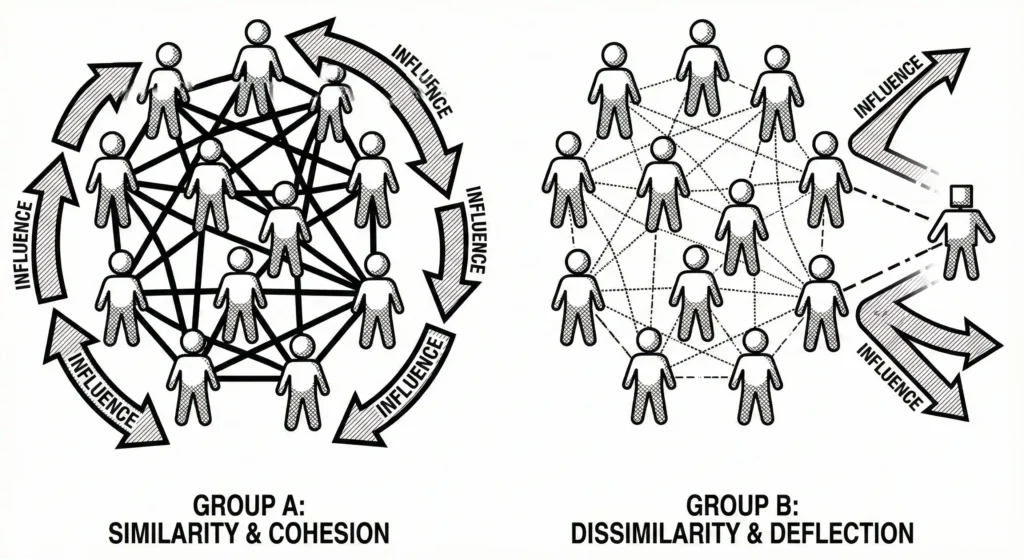
Here’s where most B2B social proof fails: the similarity requirement.
When you show a mid-market manufacturing company that a Fortune 500 tech giant succeeded with your solution, you’re not providing social proof. You’re highlighting dissimilarity. The buyer doesn’t think “if it worked for them, it’ll work for us.” They think “they’re nothing like us – different resources, different scale, different problems.”
The research is clear on this. In studies on social proof effectiveness, participants consistently weighted information from similar others more heavily than from dissimilar others – even when the dissimilar others had more impressive results. A modest success from someone “like me” beats a spectacular success from someone who isn’t.
Yet most sales teams lead with their biggest logos. The most impressive numbers. The most famous brands. They’re optimizing for what looks good on the slide, not what actually influences the buyer’s psychology.
The Sophistication Problem
Cialdini’s research also revealed something uncomfortable: awareness of influence tactics reduces their effectiveness. When people recognize they’re being influenced, they resist.
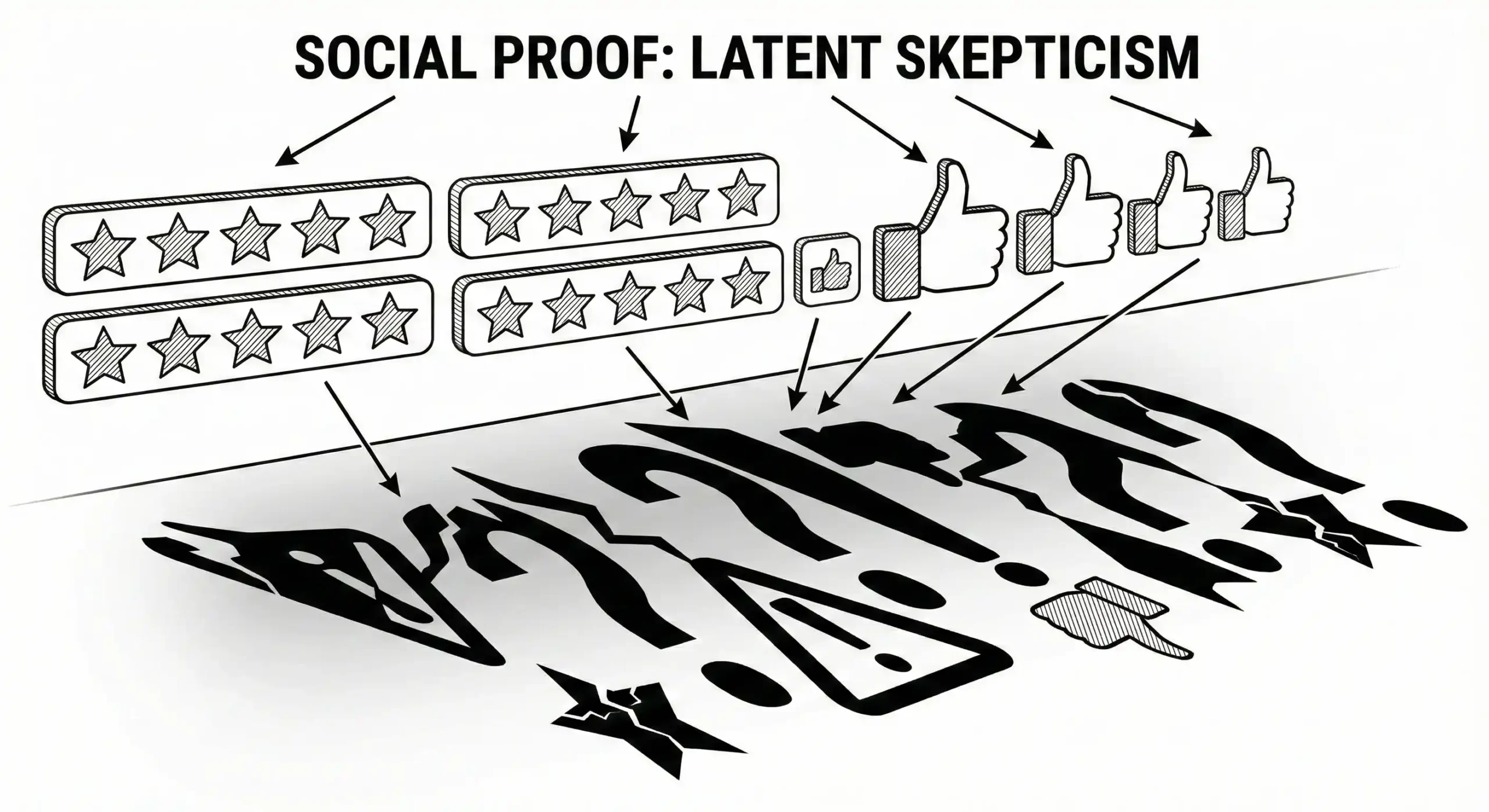
B2B buyers in 2024 are not naive. They’ve sat through hundreds of sales presentations. They know the logo slide is coming. They know the testimonials are cherry-picked. They know the case study numbers were calculated to look impressive. The tactic is visible, which means the tactic is compromised.
Research on persuasion knowledge – what happens when people recognize persuasion attempts – shows consistent patterns. Overt influence attempts trigger what psychologists call “defensive processing.” The buyer shifts from evaluating the message to evaluating the messenger’s intent. Instead of asking “is this true?” they ask “why are they trying to convince me?”
Once that shift happens, everything you say gets filtered through skepticism. The testimonial that was supposed to build trust now feels like manipulation. The case study that was supposed to inspire confidence now feels like propaganda.
The Boomerang Effect
Researchers have documented what they call the “boomerang effect” – when persuasion attempts not only fail but produce the opposite of the intended response. It happens when the influence attempt feels heavy-handed, when the source seems untrustworthy, or when the target feels their autonomy is being threatened.
B2B sales creates all three conditions with alarming frequency.
The logo parade feels heavy-handed. The polished testimonials feel untrustworthy – everyone knows companies don’t let dissatisfied customers give quotes. And the implication that “everyone else is doing it, so you should too” threatens the buyer’s sense of independent judgment.
The buyer who feels manipulated doesn’t just discount your social proof. They discount you. The testimonial slide doesn’t build the bridge to trust – it burns it.
When Social Proof Actually Works
None of this means social proof is useless. It means the standard application of social proof in B2B sales is broken.
The research suggests social proof works when it feels organic rather than staged. When the similar others are genuinely similar – same industry, same size, same challenges. When the information comes from a source the buyer discovered themselves rather than one you presented. When it validates a conclusion the buyer was already reaching rather than pushing them toward a new one.
In other words, social proof works best when it doesn’t feel like social proof. When it feels like information rather than influence. When the buyer feels they found it rather than having it pushed on them.
The conditions that make social proof effective are nearly opposite to how most sales organizations deploy it.
The Uncomfortable Implication
If social proof backfires when buyers recognize it as a persuasion tactic, and B2B buyers recognize virtually every persuasion tactic, then most of the influence toolkit is compromised.
That’s a hard conclusion to accept. It means the logo slide might be hurting more than helping. It means the testimonials might be triggering skepticism instead of trust. It means the entire apparatus of social proof – so carefully constructed, so prominently featured – might be producing the opposite of its intended effect.
The psychology is clear on the conditions for backfire. The question is whether anyone’s willing to rethink the playbook.
Ready to Question Everything?
Not everyone is. But if you are, the book is almost ready.
Instant access. No spam. Unsubscribe anytime.