Quick question: What percentage of African nations are members of the United Nations?
Don’t look it up. Just guess.
Now here’s the thing – your answer was almost certainly influenced by a number you encountered recently. Maybe a price you saw. A statistic you read. A figure in the last email you opened. Even if that number had absolutely nothing to do with African nations or the UN, it shaped your estimate.
This isn’t a party trick. It’s one of the most robust findings in behavioral psychology – and one of the least understood dynamics in B2B sales.
The Wheel of Fortune Experiment
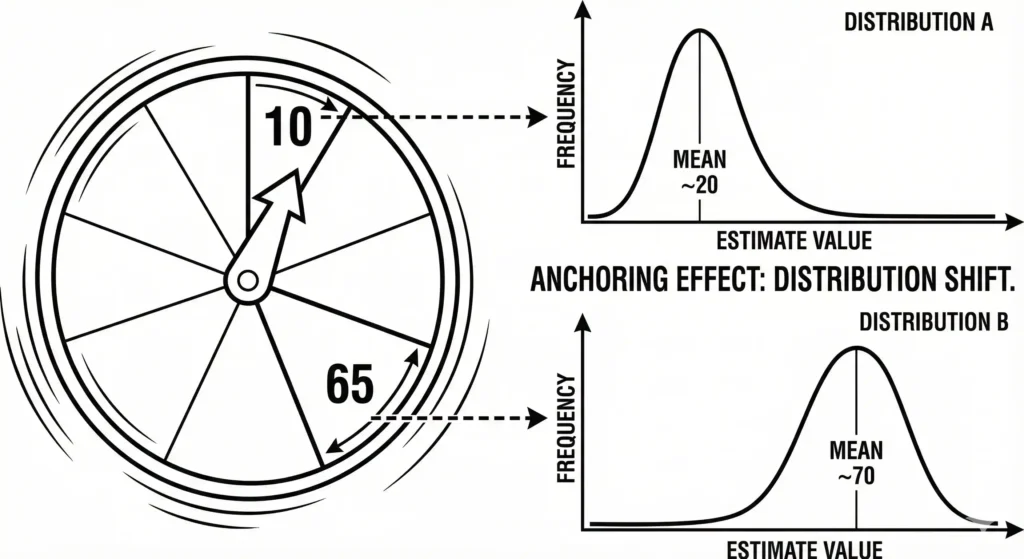
In 1974, psychologists Amos Tversky and Daniel Kahneman conducted an experiment that would become foundational to behavioral economics. As documented in their landmark paper “Judgment Under Uncertainty: Heuristics and Biases”, they asked participants to estimate the percentage of African countries in the United Nations.
But first, they spun a wheel of fortune. The wheel was rigged to land on either 10 or 65. Participants were asked whether their estimate was higher or lower than the wheel’s number, then asked for their actual estimate.
The wheel was explicitly random. Everyone knew it was random. The number it produced had literally zero informational value regarding African UN membership.
And yet.
Participants who saw the wheel land on 10 gave an average estimate of 25%. Those who saw it land on 65 gave an average estimate of 45%. A completely arbitrary, admittedly random number shifted estimates by twenty percentage points.
Tversky and Kahneman called this anchoring. And fifty years of subsequent research has confirmed it operates in virtually every context where humans make numerical judgments.
How Anchoring Works
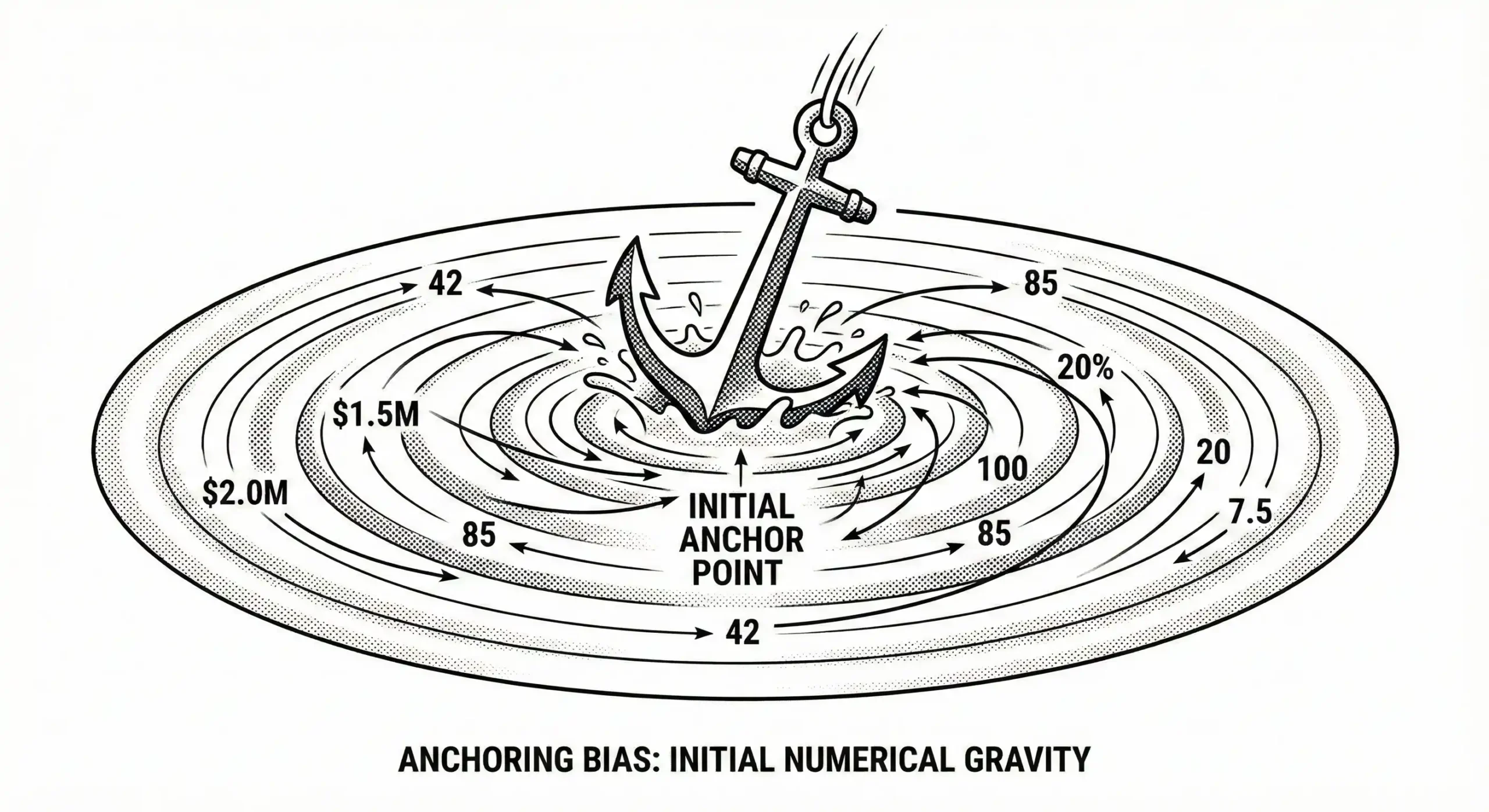
The mechanism is deceptively simple. When asked to estimate an unknown value, the brain looks for reference points. If a number – any number – is present in the environment, the brain uses it as a starting point and adjusts from there.
The problem is that adjustment is almost always insufficient. People anchor on the initial number and move away from it less than they should. The first number creates a gravitational field that subsequent thinking can’t fully escape.
What makes anchoring particularly insidious is that it works even when people are explicitly warned about it. Researchers have told participants “the number you’re about to see is random and irrelevant” – and anchoring still occurs. Knowing about the bias doesn’t neutralize it. The first number still wins.
It also works when the anchor is obviously absurd. Ask someone if Gandhi died before or after age 140, and their subsequent estimate of his actual death age will be higher than if you’d asked about age 35. The brain processes the anchor before it rejects it – and that processing leaves a residue.
Anchoring in Price Perception
The implications for negotiation and pricing are profound – and well-documented.
A 2006 study published in Current Directions in Psychological Science found that real estate agents – professionals who price properties for a living – were significantly influenced by arbitrary listing prices when estimating home values. They adjusted from the anchor just like everyone else, despite their expertise.
Research on salary negotiations shows similar patterns. When a job posting lists a salary range, candidates’ expectations anchor on those numbers. When candidates state their requirements first, employers’ offers anchor on that figure. Whoever establishes the first number shapes the entire negotiation.
The retail industry has weaponized this insight for decades. The “original price” crossed out above the sale price isn’t just showing you the discount – it’s setting an anchor. The $500 jacket marked down to $250 feels like a bargain. The same $250 jacket with no reference price feels expensive. Same jacket. Different anchor. Different perception.
The Dark Side of Anchoring
Anchoring isn’t inherently manipulative. It’s simply how human cognition works. But it becomes problematic when anchors are set strategically to distort judgment rather than inform it.
Consider the common sales tactic of starting with an inflated price specifically to make the “real” price seem reasonable. Or quoting an enormous implementation timeline so the actual timeline feels fast. Or presenting a bloated scope so the reduced scope feels like a concession.
These tactics work because of anchoring. But they also erode trust when buyers recognize them – which sophisticated B2B buyers increasingly do.
The research also reveals an uncomfortable asymmetry: anchoring affects buyers and sellers differently depending on who sets the anchor first. In most B2B sales, buyers have learned to guard against seller-set anchors. They delay pricing conversations. They refuse to name budgets. They ask for proposals before revealing constraints. These are all anchor-avoidance tactics – attempts to escape the gravitational field of a seller-controlled first number.
What the Research Reveals
Fifty years of anchoring research points to several consistent findings.
First, anchoring is universal. It affects novices and experts, quick decisions and deliberate ones, trivial estimates and high-stakes negotiations. No one is immune.
Second, the anchor doesn’t need to be relevant to be effective. Random numbers, absurd figures, and explicitly arbitrary starting points all create anchoring effects. Relevance isn’t required – presence is.
Third, awareness doesn’t eliminate the bias. Even when people know about anchoring and actively try to correct for it, they typically under-correct. The anchor’s influence persists.
Fourth, whoever sets the first anchor has a structural advantage. The sequence matters. The person who introduces the first number into a negotiation shapes the cognitive environment for everything that follows.
This creates an interesting tension in sales. Traditional advice says “don’t name a price first – let the buyer reveal their budget.” But anchoring research suggests whoever speaks first has significant influence over the final outcome. The tactics are at odds with the science.
The Question This Raises
Anchoring isn’t new. Retailers have used it forever. Negotiation experts teach it in every course. So why does B2B sales still treat pricing conversations as adversarial games of “you go first”?
The answer probably lies in how the research has been applied – or misapplied. Anchoring has been treated as a manipulation tactic rather than a cognitive reality to be navigated honestly. And buyers, burned by too many artificially inflated anchors, have built defenses that make pricing conversations more difficult for everyone.
Understanding anchoring is essential. But knowing what to do with that understanding – how to navigate pricing conversations in a way that acknowledges cognitive reality without exploiting it – is a different question entirely.
That’s the question we’re working on. Join the waitlist if you want to know what we find.
Seeing Similar Patterns?
I'm writing a book about what happens when you flip the assumptions. Real stories. Real results. Anonymized, but true.
Instant access. No spam. Unsubscribe anytime.