Here’s a question that will change how you think about selling:
Why do buyers stick with solutions that are clearly inferior to yours?
You’ve seen it a hundred times. Your product is objectively better. The ROI is obvious. The buyer even admits their current solution is painful. And yet they don’t switch.
They stick with the devil they know. They renew the contract with the vendor they complain about. They keep using the spreadsheet that breaks every month.
This isn’t stupidity. It isn’t laziness. It isn’t even risk aversion in the way most people think about it.
It’s a deeply researched psychological phenomenon called the Endowment Effect. And until you understand it, you’ll keep losing deals to inferior competition.
The Coffee Mug That Changed Economics
In 1990, three researchers – Daniel Kahneman, Jack Knetsch, and Richard Thaler – ran a simple experiment at Cornell University that would eventually help win a Nobel Prize.
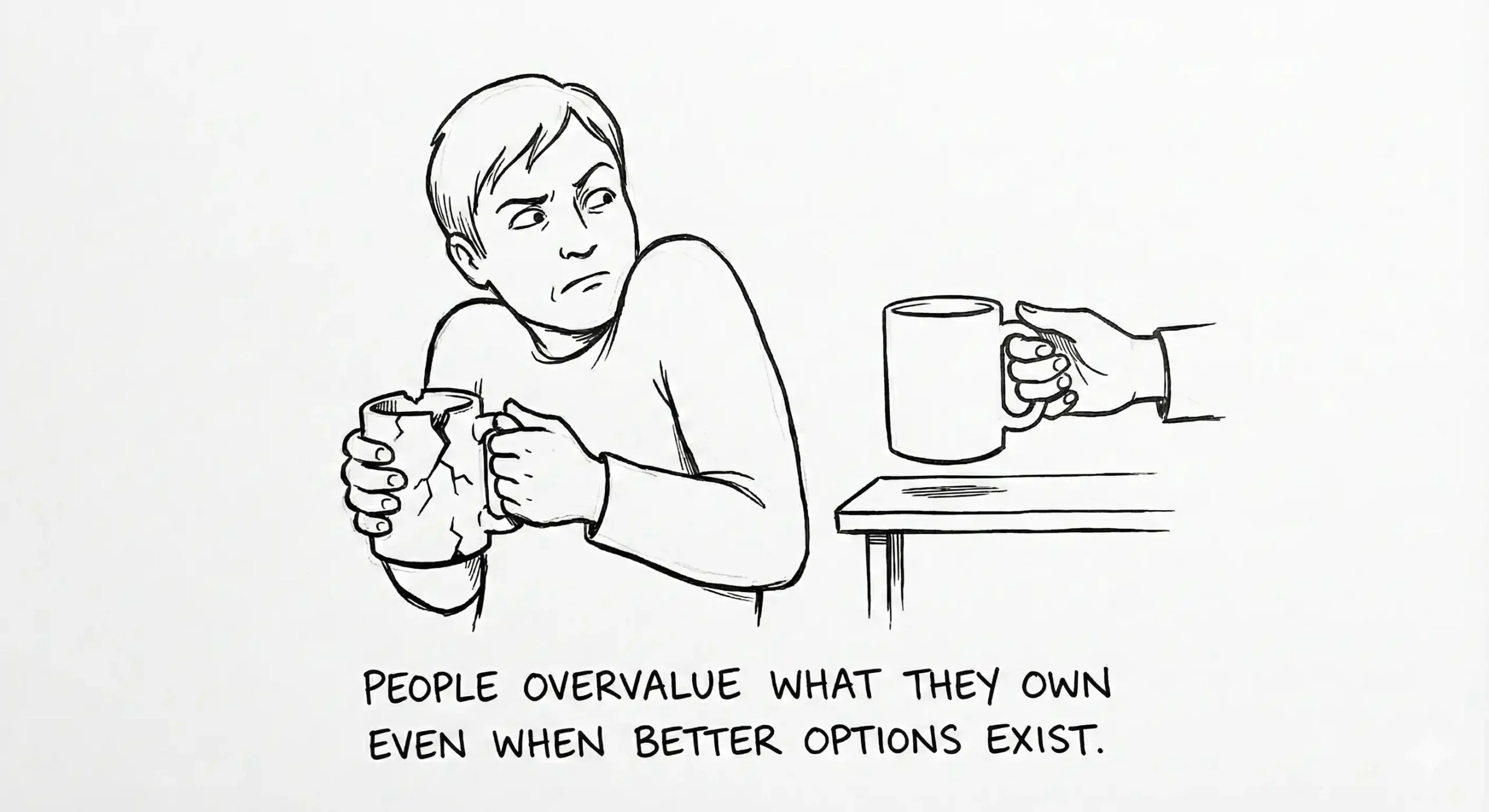
They gave coffee mugs to half the students in a classroom. Plain Cornell coffee mugs, nothing special. Then they created a market where mug owners could sell to non-owners.
Standard economic theory predicted about half the mugs would trade. After all, preferences should be random – some owners would prefer cash, some non-owners would prefer mugs.
That’s not what happened.
The mug owners demanded about twice as much to sell their mugs as non-owners were willing to pay to buy them. The median selling price was $5.25. The median buying price was $2.75.
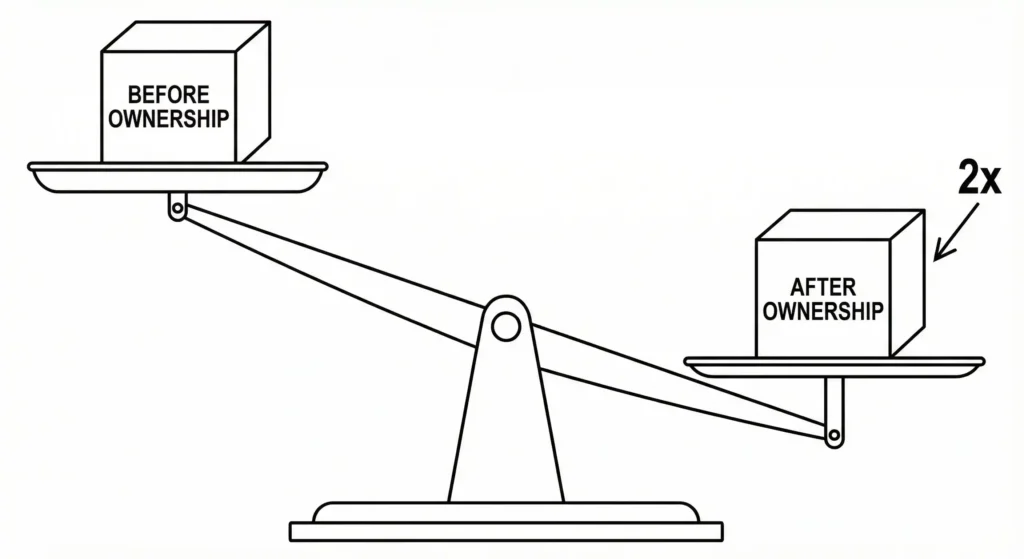
Same mug. Same students. But the simple act of owning it made it worth twice as much to the owner.
They called this the Endowment Effect: the tendency to overvalue things simply because we own them. And it’s been replicated hundreds of times across different contexts, cultures, and stakes.
It’s Not About the Mug
Here’s where it gets interesting for sales.
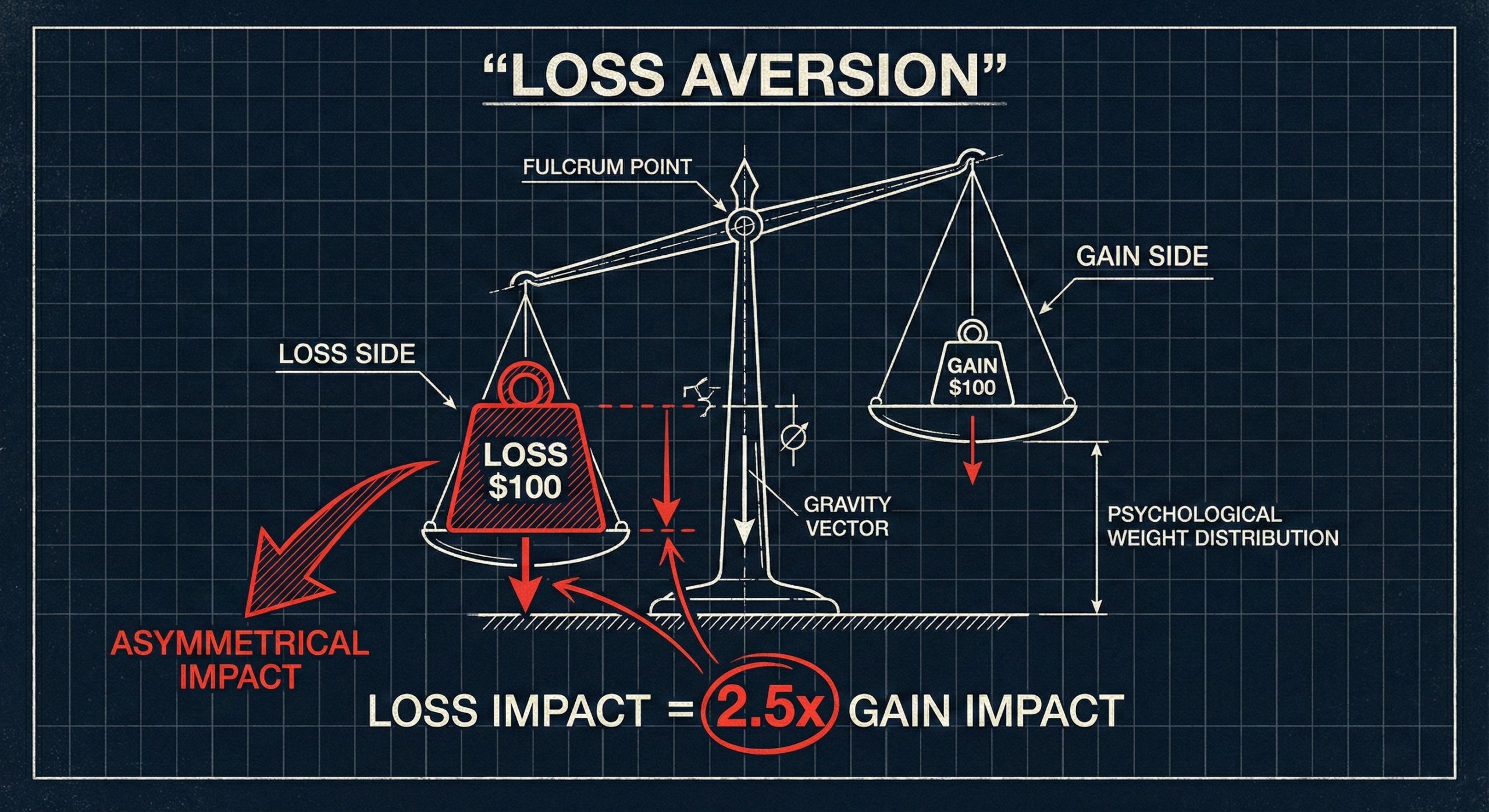
The endowment effect isn’t about mugs or physical objects. It’s about psychological ownership. Kahneman and his colleagues linked it directly to loss aversion – the finding that losses hurt approximately 2.5 times more than equivalent gains feel good.
When you own something, giving it up feels like a loss. And losses hurt. So you overvalue what you have to justify not losing it.
Now think about your buyer.
They own their current solution. They chose it. They implemented it. They learned it. They’ve built workflows around it. Their team knows how to use it.
That solution is theirs. And giving it up – even for something better – feels like a loss.
Your buyer’s crappy legacy system isn’t just familiar. It’s theirs. And that ownership makes them value it far more than it deserves.
The Incumbent’s Unfair Advantage
This is why displacement selling is so brutally hard.
You’re not just competing against the incumbent’s features. You’re competing against the psychological weight of ownership itself.
The buyer has endowed their current solution with extra value simply because it’s theirs. Even when they complain about it – “it’s clunky,” “support is terrible,” “we’ve outgrown it” – they’re still overvaluing it.
This creates an asymmetry that traditional sales training completely ignores.
You show up with an ROI calculation: “Our solution will save you $500,000 per year.” That sounds compelling. But the buyer hears: “Give up what you have – take a loss – for a potential gain.”
Loss versus gain. The loss weighs heavier. Even when the math says otherwise.
Your $500,000 gain has to overcome not just the switching costs, not just the implementation risk, but the psychological weight of giving up something they own.
Status Quo Bias: The Endowment Effect’s Partner
The endowment effect doesn’t work alone. It partners with something researchers call status quo bias – an irrational preference for the current state of affairs.
In their 1991 paper published in the Journal of Economic Perspectives, Kahneman, Knetsch, and Thaler documented how these biases reinforce each other. The status quo becomes the reference point. Any change is evaluated as a potential loss from that reference point. And losses hurt more than gains help.
The result? Inertia. Powerful, irrational, deal-killing inertia.
This explains the buyer who says “your solution is better” but doesn’t buy. The one who admits “we need to change” but never does. The deal that stalls indefinitely at “no decision.”
They’re not being dishonest. They genuinely believe your solution is better. But the psychological weight of their current ownership is stronger than the logical case for change.
Why Your Demo Makes It Worse
Here’s the uncomfortable part.
Most sales processes actively reinforce the endowment effect instead of overcoming it.
You give a demo. You show features. You compare your solution to their current one. Every comparison reminds them of what they have. Every feature gap reminds them that switching means losing the things they’ve learned to work around.
You calculate ROI. But ROI is a gain story. “Here’s what you could have.” The endowment effect says gains don’t motivate as much as losses hurt.
You build a business case. But the business case implicitly asks: “Is this gain worth the loss of what you currently own?” And the answer is usually no – not because the math is wrong, but because the psychology is stacked against you.
The traditional sales process treats buyers as rational calculators. They’re not. They’re humans with psychological biases that make them cling to what they have.
What This Means for Selling
If the endowment effect means buyers overvalue what they have, what’s the counter-strategy?
The research points to a few possibilities.
First, stop selling gains. Start surfacing losses. The buyer isn’t losing their current solution by switching – they’re already losing something by staying. Every day they keep the status quo, they’re losing money, time, opportunity. Make that loss vivid. Make them feel it.
Second, recognize that the decision to change has to happen before the decision of what to change to. The endowment effect keeps them anchored to the status quo. Your job isn’t to show them a better option – it’s to make keeping the current option feel like the bigger loss.
Third, consider what would happen if the buyer built ownership of something else. What if they owned the problem definition? What if they owned the business case? The endowment effect works both ways. Ownership creates value. Whose ownership are you building?
The Hidden Variable
I keep coming back to this research because it explains so much of what we see in sales but can’t explain with traditional frameworks.
Why do buyers say yes but then do nothing? Endowment effect.
Why does “no decision” kill more deals than competitors? Status quo bias.
Why do great ROI stories fail to close? Because gains don’t overcome the psychological weight of loss.
The endowment effect is the hidden variable in every displacement sale. It’s the force you’re fighting against without knowing it. And until you account for it, you’ll keep wondering why obviously better solutions lose to obviously worse ones.
The buyer isn’t irrational. They’re human. And humans overvalue what they have.
Your job is to work with that psychology, not against it.
Still Asking the Same Questions?
Join the waitlist if you want to know when the questions finally become answers. Or at least better questions.
Instant access. No spam. Unsubscribe anytime.