I need to tell you about Daniel Kahneman and Amos Tversky.
I found their research last weekend. I’ve read the same paper four times now. I can’t stop thinking about it.
These two psychologists – one of them won a Nobel Prize for this work – discovered something about human decision-making that changes everything I thought I knew about sales.
And somehow, in thirty years of selling, nobody ever told me about it.
What They Discovered
In 1979, Kahneman and Tversky published a paper called “Prospect Theory: An Analysis of Decision Under Risk.” It’s dense. Academic. Not exactly a page-turner.
But buried in the equations and experiments is a finding that should have revolutionized sales:
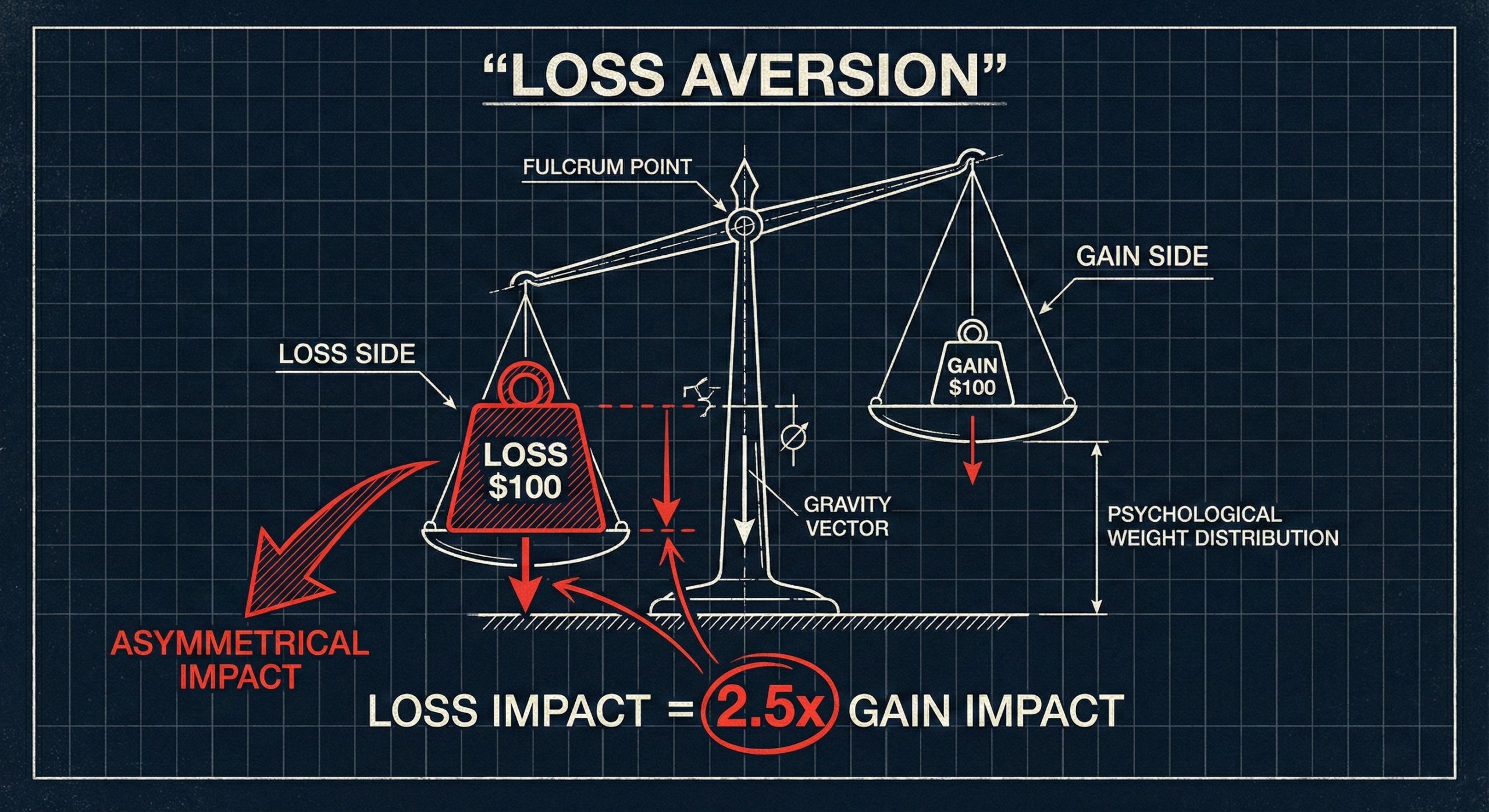
Losses hurt roughly 2.5 times more than equivalent gains feel good.
Read that again.
If you lose $100, the psychological pain is about 2.5 times stronger than the pleasure you’d feel from gaining $100.
They called it “loss aversion.” And they proved it across hundreds of experiments, thousands of subjects, decades of research.
This isn’t opinion. This is one of the most replicated findings in behavioral science.
Why This Changes Everything About Sales
Think about how we sell.
Every pitch is about gains. Here’s what you’ll get. Here’s how much better things will be. Here’s the ROI. Here’s the value.
Gains, gains, gains.
But if losses are 2.5x more powerful than gains, we’ve been using the weaker lever. We’ve been pushing with one hand when we could have been pulling with both.
What if instead of talking about what they’ll gain, we helped buyers see what they’re already losing?
Not in a manipulative, fear-mongering way. But genuinely – what is the status quo actually costing them? What are they losing every month they don’t solve this problem?
That loss is 2.5x more motivating than any gain we could promise.
The Math That Keeps Me Up at Night
Let me put this in concrete terms.
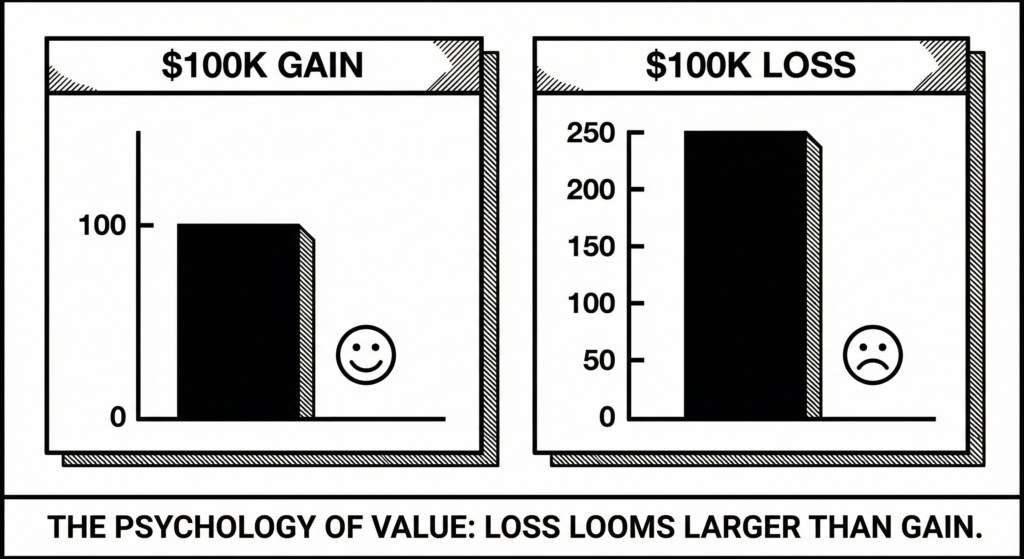
Say your solution saves a company $100,000 a year. That’s your pitch, right? “We’ll save you $100K.”
But psychologically, that $100K gain has a certain motivational weight. Let’s call it 100 units of motivation.
Now flip it. Instead of “you’ll save $100K,” what if you helped them see “you’re currently losing $100K every year you don’t fix this”?
Same number. Same $100K. But now it’s a loss, not a gain.
Motivational weight? 250 units. Two and a half times more powerful.
We’ve been leaving 150% of our persuasive power on the table.
Why Nobody Talks About This
I’ve been in sales for three decades. I’ve read the books. Done the trainings. Learned the methodologies.
Not once – not a single time – did anyone teach me about loss aversion.
Why?
I think it’s because all the major sales methodologies were developed before behavioral economics went mainstream. SPIN came out in 1988. Sandler in the 60s. Even Challenger in 2011 barely touches this.
The science existed, but it stayed in academia. It never made it to the sales floor.
Meanwhile, we’ve been pitching gains to buyers whose brains are wired to respond to losses.
We’ve been speaking the wrong language.
What I’m Going to Do With This
I’m not done with this research. There’s more in Kahneman and Tversky’s work – concepts like reference points and framing effects that I’m still digesting.
But I know enough now to say this: the framework I’ve been building just found its foundation.
The inverse relationship I’ve been observing – where pushing harder produces worse results – I think loss aversion is part of why. When we push gains, we’re using weak motivation. When the buyer discovers their own losses, they motivate themselves.
I need to think about this more. Test it. See if it holds up in real deals.
But for the first time in months, I feel like I’m not just noticing patterns.
I’m starting to understand them.
This Post Hit a Nerve?
Join the waitlist if you've been asking similar questions. Or if this made you start asking them.
Instant access. No spam. Unsubscribe anytime.