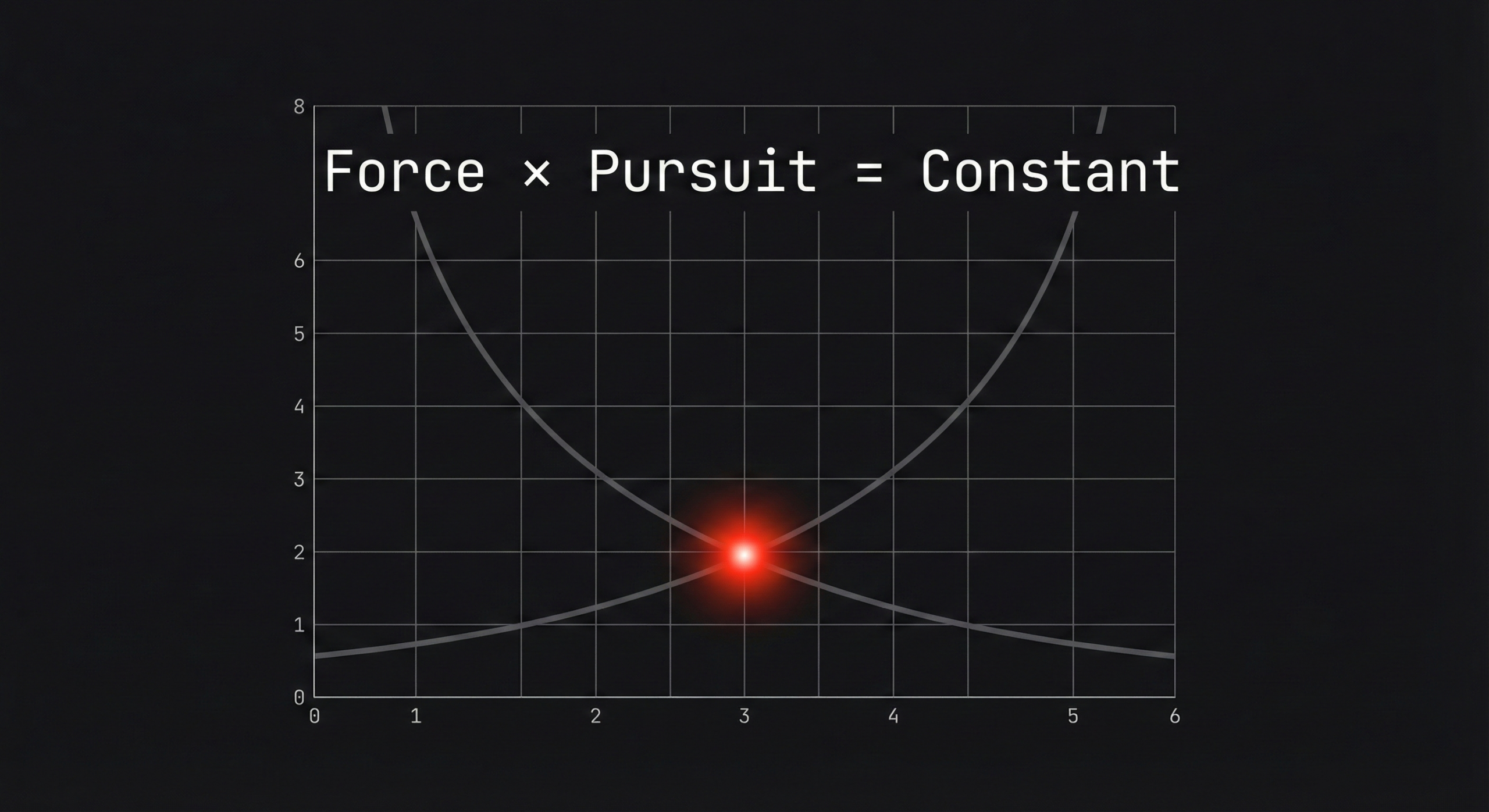
The Pitch That Always Falls Flat
You’ve done this a hundred times.
You walk into a meeting armed with ROI calculations. You’ve built a beautiful slide showing how your solution will increase revenue by 15%, reduce costs by 20%, improve efficiency by 30%. The math is airtight. The value is obvious.
The prospect nods politely. They say the numbers look interesting. They ask you to send over the deck.
And then… nothing. The deal stalls. They go dark. Eventually you learn they decided to “stay the course” or “revisit next quarter” or “focus on other priorities.”
Your ROI was compelling. Your logic was sound. So why didn’t it work?
Because you were selling gains. And gains don’t move people.
The Nobel Prize That Explains Everything
In 1979, two psychologists – Daniel Kahneman and Amos Tversky – published a paper that would eventually win the Nobel Prize in Economics. It was called “Prospect Theory: An Analysis of Decision Under Risk.”
The core finding was simple but revolutionary: humans don’t evaluate outcomes in absolute terms. We evaluate them relative to a reference point – usually our current state. And we’re not symmetrical about it.
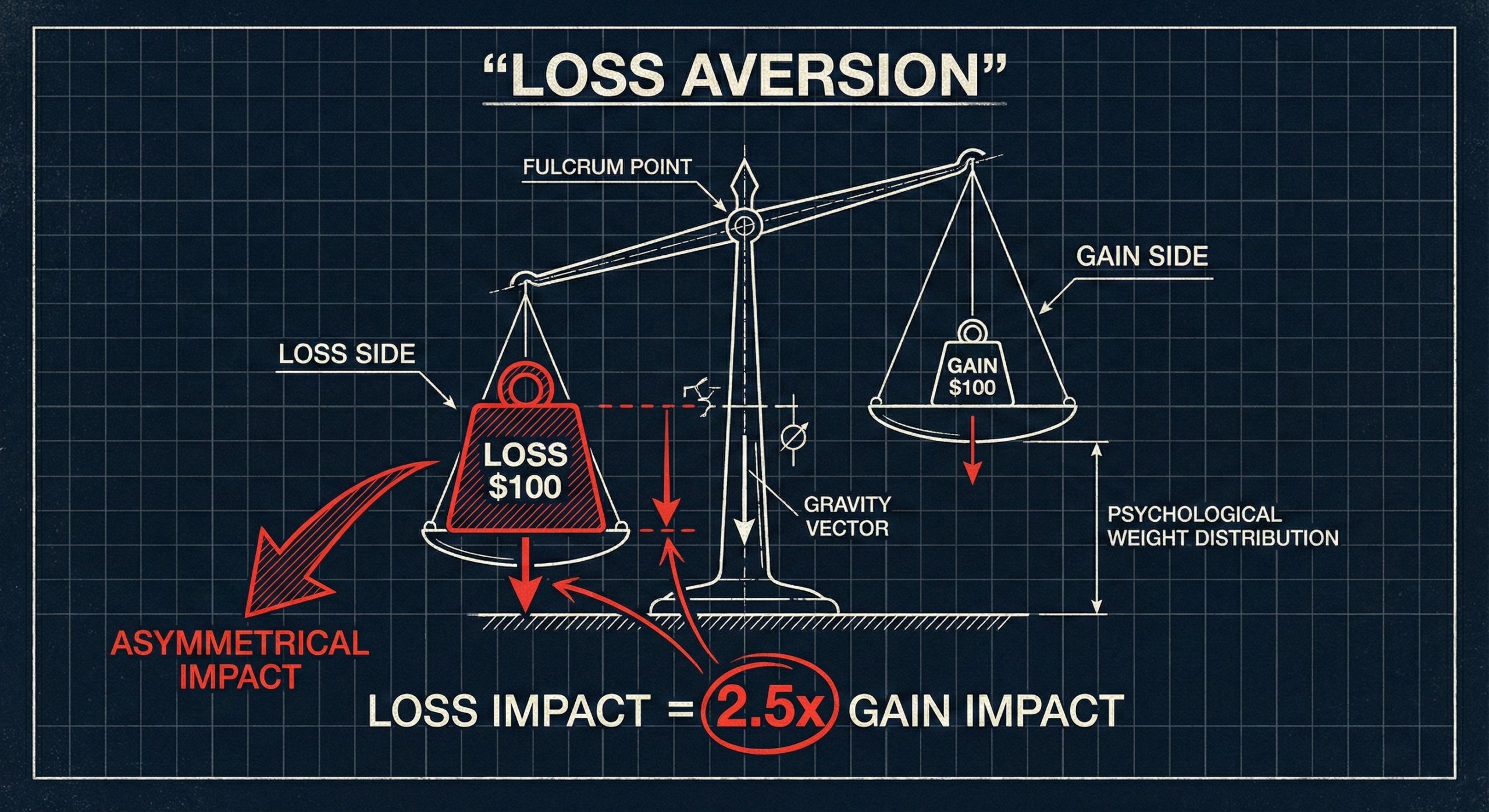
Losses hurt more than equivalent gains feel good.
Not a little more. A lot more. The research suggests roughly 2 to 2.5 times more.
Lose $100 and you feel a certain amount of pain. Win $100 and you feel good – but only about 40% as intensely as the loss hurt. To feel as good as the loss felt bad, you’d need to win $200-$250.
This is loss aversion. And it’s not a quirk or a bias to be corrected. It’s how human beings are wired.
Why This Destroys Traditional Sales Pitches
Think about what most sales training teaches you to do:
Lead with value. Show the ROI. Paint a picture of the better future. Help them see what they’ll gain.
All of that is selling into the weaker half of human psychology.
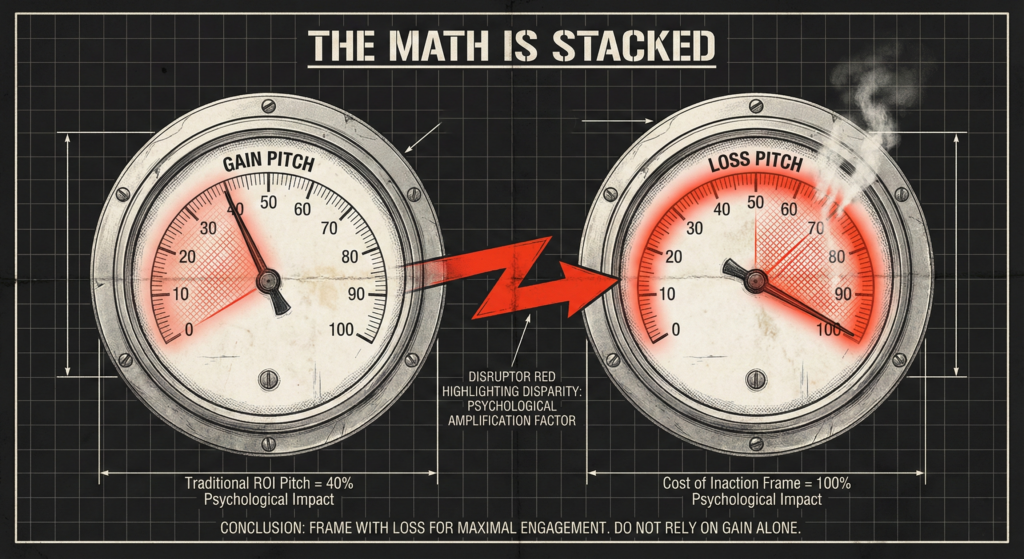
When you pitch “you’ll gain 15% more revenue,” you’re appealing to a motivation that – according to decades of research – operates at roughly 40% power compared to loss.
The buyer hears your gain pitch. They nod. It sounds nice. And then they weigh it against the losses involved in making a change: the risk of implementation failure, the pain of switching systems, the political capital they’d spend, the possibility of looking foolish if it doesn’t work.
Your gains are operating at 40% power. Their perceived losses are operating at 100%.
No wonder “no decision” wins so often.
The Asymmetry Nobody Talks About
Here’s what makes this even more insidious:
The status quo – their current state – is psychologically “theirs.” They own it. It’s the reference point. And anything they currently have is subject to the endowment effect – another Kahneman finding that shows we value things we possess more than identical things we don’t.
So when you pitch a change, you’re not just fighting loss aversion on the potential downside of your solution. You’re fighting the endowment effect on everything they’d have to give up from their current approach.
Their crappy existing system? They own it. Their inefficient manual process? It’s theirs. Their mediocre vendor relationship? Familiar and therefore comfortable.
You’re asking them to trade something they have (overvalued because they possess it) for something they don’t have (undervalued because it’s just a promise of gain).
The math is stacked against you before you open your mouth.
The Inversion: Selling What They’ll Lose
If loss aversion means losses hit 2.5x harder than gains, why would you ever lead with gains?
The answer, of course, is that most salespeople don’t know this. And even those who do have been trained so thoroughly in “positive selling” and “value communication” that they can’t bring themselves to do anything different.
But the physics is clear:
If you want to move someone to action, show them what they’re losing by staying where they are.
Not what they’ll gain by moving. What they’re actively losing right now. What’s slipping away. What’s being taken from them by their current situation.
This isn’t manipulation. It’s alignment with how human brains actually process decisions. You’re not creating false fear – you’re helping them see a real cost they’ve been blind to because they’ve normalized it.
The Cost of Inaction Frame
The most powerful question in sales isn’t “What would you gain from solving this?”
It’s “What is this problem costing you every month you don’t solve it?”
That reframe does something profound. It takes your solution out of the “potential gain” category and puts the status quo into the “active loss” category.
They’re not weighing “should I spend money to maybe get something better?” They’re weighing “can I afford to keep losing this every single month?”
Same situation. Completely different psychological weight. Because losses loom larger than gains.
Making It Concrete
Let’s say you’re selling a sales enablement platform. Traditional pitch:
“Our platform will help your reps close 20% more deals by giving them the right content at the right time.”
Sounds good. Appeals to gain. Operates at 40% psychological power.
Loss aversion reframe:
“Right now, your reps are losing about one in five deals they should win because they can’t find the right case study or data point when the buyer asks for it. That’s not a future problem – that’s money walking out the door this quarter.”
Same underlying value proposition. Completely different framing. Now you’re operating at 100% psychological power.
Why This Feels Wrong
If you’re like most salespeople, something about this feels negative. Pushy. Fear-based.
That’s the conditioning talking. You’ve been taught that positive selling is ethical and negative framing is manipulation.
But think about it differently: if your solution genuinely helps, and they genuinely have a problem, then the cost of inaction is real. You’re not inventing fear – you’re illuminating a cost they’ve been too close to see.
The real manipulation is knowing about loss aversion and still selling gains – watching deals die, knowing you could have framed it differently, but choosing not to because “positive selling” feels more comfortable.
You’re not serving the buyer by letting them stay blind to what they’re losing. You’re serving yourself by staying in your comfort zone.
The Application
Here’s the practice:
Take your current pitch – whatever you lead with. Find every place where you’re promising a gain. Then invert it.
“You’ll increase revenue” becomes “You’re losing revenue every day this goes unsolved.”
“You’ll save time” becomes “Your team is wasting hours every week on a problem that has a solution.”
“You’ll improve customer satisfaction” becomes “Customers are walking away right now because of this gap.”
Same facts. Different frame. 2.5x the psychological impact.
Loss aversion isn’t a sales trick. It’s the physics of human decision-making. You can fight it, or you can work with it.
The choice is yours. But the math isn’t.
The Old Way Is Dead.
57% miss quota. 40-60% lost to "no decision." The System is broken. This is the fix.
Instant access. No spam. Unsubscribe anytime.