The Challenger Sale was published in 2011 – the same year the iPhone 4S launched and LinkedIn had 100 million users.
Cold email response rates were 10-15%. Buyers still valued vendor expertise because they couldn’t easily access it elsewhere. “Commercial teaching” – the Challenger’s core move – worked because buyers hadn’t been taught yet.
Fourteen years later, LinkedIn has over a billion users. Cold email response rates have collapsed to 5.8%. And every buyer has been “taught” by hundreds of salespeople using the same methodology.
The Challenger Sale isn’t wrong. It’s just not enough anymore.
What Challenger Got Right
Let’s start with credit. Dixon and Adamson’s research was rigorous, and their core insights remain valid:
Relationship builders underperform. The data was clear: sellers who focused primarily on building rapport and being likable consistently underperformed compared to sellers who challenged buyer thinking. The “friend” approach doesn’t close complex deals.
Buyers value challenge over comfort. The research showed that buyers respect sellers who push back, reframe their assumptions, and bring perspectives they hadn’t considered. Being a “yes person” signals low status.
Constructive tension drives action. Challenger made it acceptable – even desirable – to create tension in enterprise sales conversations. This was a significant shift from the “consultative” orthodoxy of the time.
These insights were real. They changed how a generation of salespeople approached complex deals.
So what broke?
The Teaching Problem
Challenger’s formula is “teach, tailor, take control.” The teaching component – “commercial teaching” – is where the methodology shows its age.
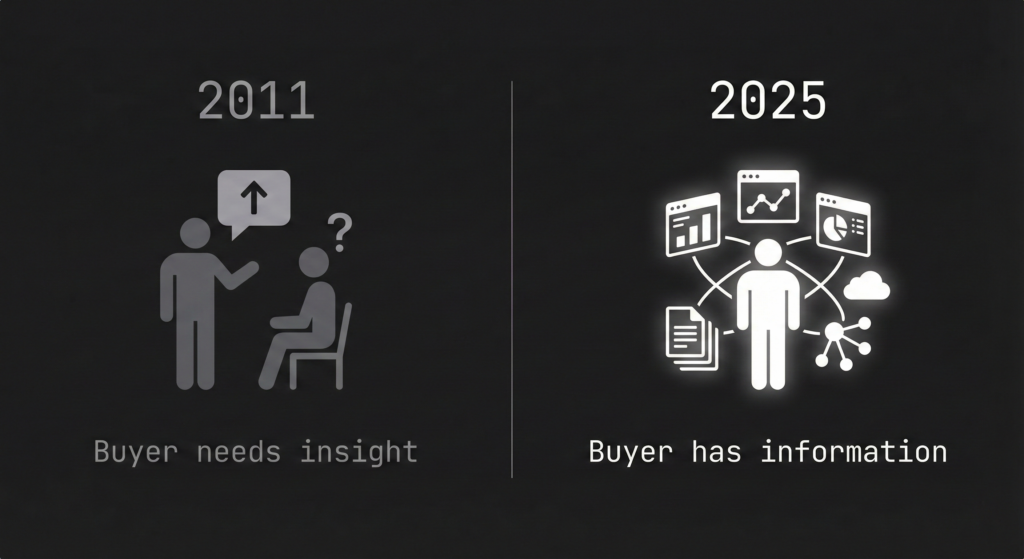
In 2011, buyers still valued vendor expertise because information was scarce. A seller who could share industry benchmarks, peer data, or strategic insights was providing genuine value. The buyer couldn’t easily find this information elsewhere.
In 2025, buyers have access to the same analyst reports, peer reviews, case studies, and benchmarks that sellers do. They’ve read the Gartner reports. They’ve seen the G2 reviews. They’ve talked to their network. They’ve formed opinions before the first call.
“Teaching” them something they can Google in 30 seconds doesn’t feel valuable. It feels patronizing.
When a Challenger rep opens with “Let me share an insight about companies in your situation…” the modern buyer often thinks: I’ve heard this before. From your competitor. And the one before that.
The insight isn’t differentiated. The teaching isn’t novel. And the buyer recognizes when they’re being walked through a methodology.
The Control Problem
“Take control” was always the most controversial part of Challenger. It assumed sellers have leverage.
In 2011, sellers still had some information advantage. Buyers needed vendors to understand their options fully. This created leverage – the seller controlled access to information the buyer wanted.
In 2025, buyers complete 70-80% of their journey before engaging sales. They’ve already shortlisted vendors. They’ve already formed opinions. They don’t need you for information – they have more information than your pitch deck.
Against sophisticated buyers with multiple options, attempting to “control” creates resistance. It triggers reactance – the psychological pushback people feel when someone tries to limit their choices or tell them what to do.
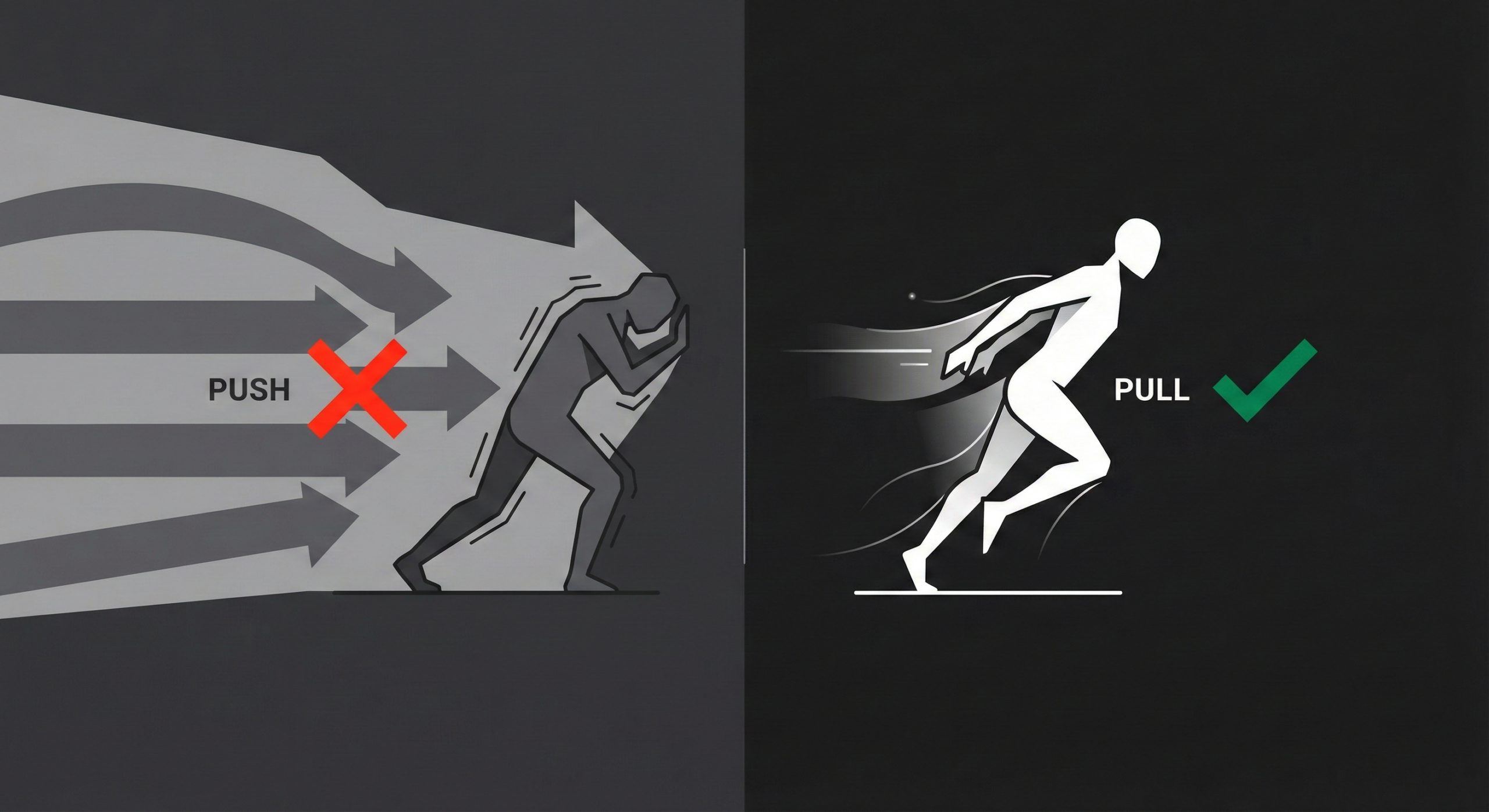
The harder you push for control, the harder they pull away.
The Seller-Centric Problem
Here’s the fundamental issue: Challenger focuses on what the seller does, not what the buyer commits to.
A Challenger rep can execute a perfect commercial teaching conversation – delivering insight, creating tension, pushing the buyer to think differently – and still have no idea if the deal is real.
Challenger tells you how to have better conversations. It doesn’t tell you how to know if a deal should be in your pipeline. It doesn’t require buyer commitment at each stage. It doesn’t distinguish between a buyer who was impressed by your insight and a buyer who will actually take action.
You can “challenge” someone all day long. If they don’t commit to anything, you don’t have a deal – you have a performance.
The Deeper Issue: Push vs. Pull
Challenger is fundamentally a push methodology. The seller delivers insight. The seller creates tension. The seller takes control.
Every verb is seller-initiated.
This made sense in 2011. Buyers needed sellers to push them toward clarity because they couldn’t get there on their own.
But today’s buyer has done their homework. They don’t need to be taught – they need their thinking validated or challenged through questions, not lectures. They don’t need to be controlled – they need to own the math of their own decision.
When you tell someone their problem is serious, they can disagree. They can argue. They can dismiss you as a vendor with an agenda.
When they tell themselves their problem is serious – through answering your questions – they can’t un-know it. The insight is theirs, not yours. The commitment is internal, not external.
Challenger creates awareness. But awareness isn’t ownership. And only ownership closes deals.
What Works Instead
The principle behind Challenger – that passive, relationship-focused selling underperforms – is still true. But the execution needs to evolve.
Instead of teaching, try asking. The Challenger rep delivers insights: “Companies like yours are losing 23% of productivity to this problem.” The better approach asks questions that lead the buyer to discover their own crisis: “If your lead architect leaves, what happens to your Q4 deadline?”
Instead of taking control, try pulling away. Challenger pushes harder when buyers resist. The alternative is the negative reverse – pulling away when you sense resistance, which often causes buyers to pull toward you.
Instead of seller-delivered insight, try buyer-verified consequence. Don’t tell them what the problem costs. Help them calculate it themselves. A buyer who owns the math of their own failure closes themselves.
Instead of tracking conversations, track commitments. Every stage of a deal should require explicit buyer agreement – not your assessment that the conversation went well.
The tension Challenger created was valuable. But tension through teaching is less effective than tension through diagnostic questions that force buyers to confront their own situation.
The Verdict
The Challenger Sale correctly identified that passive, relationship-focused selling underperforms. That insight remains true.
But “teach, tailor, take control” was built for a world where buyers needed vendors to show them what they were missing. That world ended around 2015 and isn’t coming back.
Today’s buyer doesn’t need a teacher. They need a peer who respects that they’ve already done their homework. They don’t need to be controlled. They need to own the decision themselves.
Challenger gave us the courage to create tension. Now we need a methodology that creates ownership.
First Access. No Spam.
The waitlist exists for one reason: to tell you when the methodology drops. That's it.
Instant access. No spam. Unsubscribe anytime.