The Question
In my last post, I told you about the Marcus meeting. The moment I said “I don’t know” to an angry Fortune 500 executive and watched the entire dynamic of the room flip.
But I didn’t explain why it worked.
Why would admitting uncertainty – the opposite of everything I’d been trained to do – cause a hostile buyer to lean in instead of kick me out?
The answer isn’t intuition. It’s not luck. It’s not even sales technique.
It’s physics. And biology. And psychology that’s been studied for decades – but never connected to how we actually sell.
The Biology
Why is it so hard to do what I did in that conference room?
Why, when Marcus yelled, was my instinct to apologize and sell?
Because your biology is wired to fail at sales.
For 200,000 years, human beings lived in tribes of 50 to 150 people – what anthropologist Robin Dunbar calls “Dunbar’s Number.” In that environment, social rejection equaled death. If the tribe didn’t like you, they kicked you out, and you died of exposure or were eaten by a predator.
Your brain – specifically the amygdala – evolved a survival mechanism: Appease the Alpha.
When someone with high status challenges you, your brain screams: “Make them happy! Fit in! Don’t offend them!”
Neuroscientist Joseph LeDoux’s research reveals the mechanism: when you perceive a status threat, your brain triggers a cortisol response in milliseconds – faster than conscious thought. Before you can reason through the situation, your body is already preparing for fight, flight, or appease.
UCLA researchers Naomi Eisenberger and Matthew Lieberman discovered something even more alarming: fMRI scans show that social rejection activates the same brain regions as physical pain.
When Marcus challenged us, my brain processed it as if he had physically threatened me. No wonder my instinct was to make the pain stop.
The Symptoms
This is why, despite all your training, you still do things you know are wrong:
You lower your price when they frown.
You talk too much to fill the silence.
You agree to unrealistic timelines just to keep the deal alive.
You are not fighting the client. You are fighting 200,000 years of evolutionary programming that tells you Compliance = Safety.
But in modern sales, Compliance = Death.
When you comply, you signal low status. You signal that you are a commodity. And wealthy people do not trust commodities – they exploit them.
Reactance Theory
What I did in that conference room wasn’t just counterintuitive – it was scientifically precise. It triggered a psychological response discovered by Jack Brehm in 1966 called Reactance Theory.
The law states: When a person feels their freedom of choice is threatened, they will instinctively push back to regain control.
Brehm’s original experiments demonstrated this with startling clarity. In one study, participants were told they could choose between several options – but then one option was removed. The restricted option immediately became more desirable, with participants rating it 47% higher than before it was restricted.
The “forbidden toy” experiments with children showed the same pattern: tell a child they can’t have a specific toy, and that toy becomes the only thing they want.
The Physical Metaphor
Imagine I walk up to you and place my palms on your chest. What’s your instinct?
Push back.
Now imagine I place my palms on your chest and start stepping backward – pulling you toward me.
What’s your instinct now?
Resist. Lean back. Pull away.
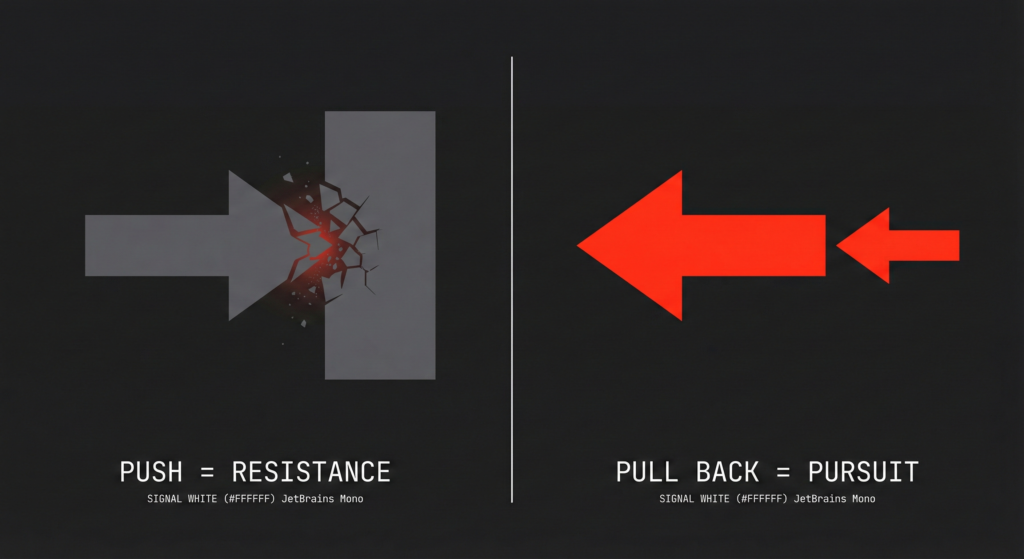
This is the physics of human interaction. Push, and they resist. Pull back, and they pursue.
Every pushy sales tactic – the aggressive follow-up, the urgency close, the “limited time offer” – triggers reactance. The buyer’s unconscious response is to push back, to resist, to protect their autonomy.
When I said “I don’t know” and questioned Marcus’s readiness, I wasn’t pushing. I was pulling back. I was giving him space. His instinct was to fill that space – to pursue.
The Equation
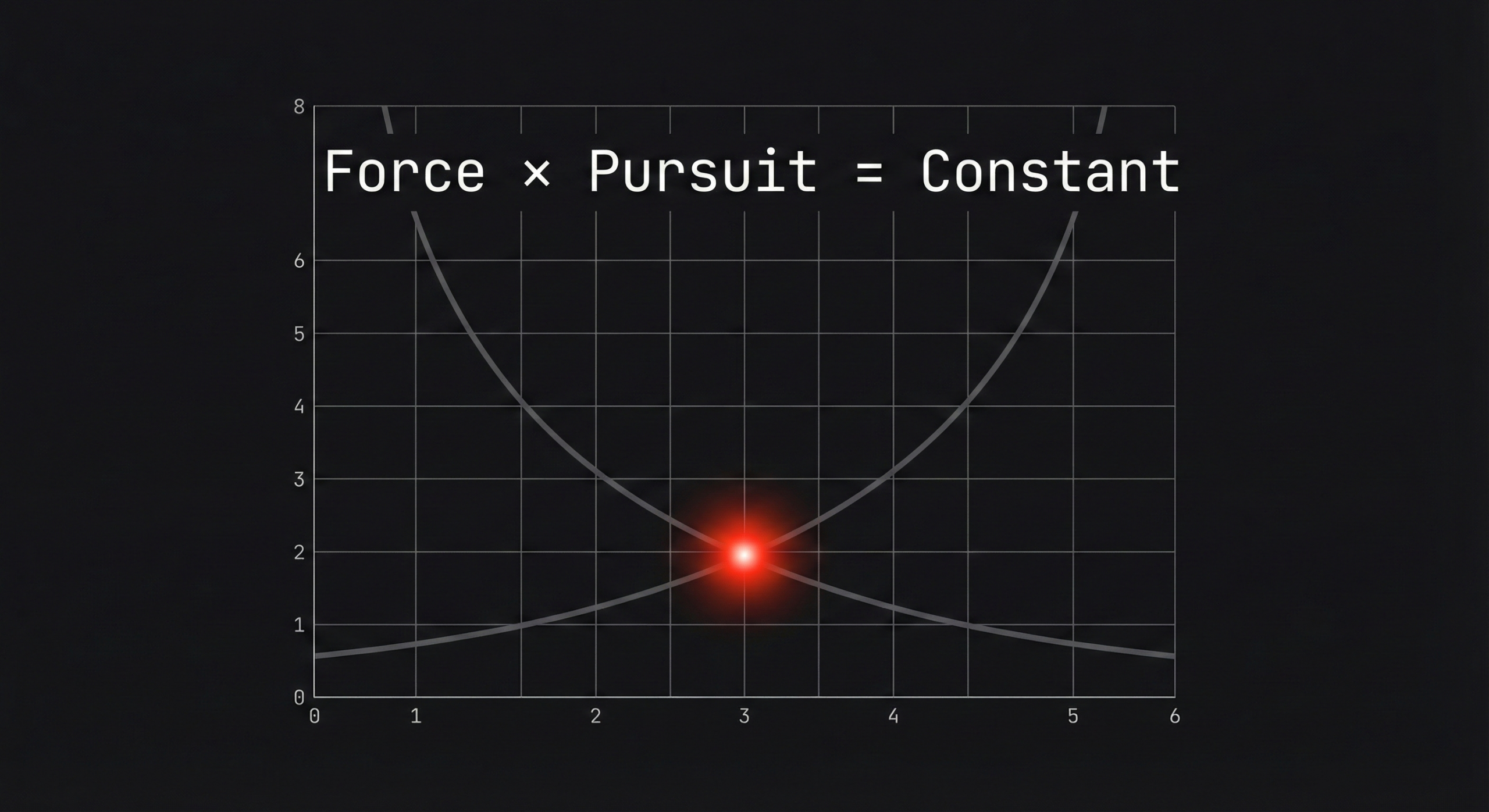
In mathematics, two variables are inversely proportional when one increases as the other decreases – their product always equals a constant.
Speed and time traveling a fixed distance. Pressure and volume in a closed system. The faster you go, the less time it takes. The harder you compress, the more it pushes back.
Sales operates on the same physics.
Seller Force × Buyer Pursuit = Constant
When you push hard, you own the work. You own the urgency. You own the math. And when you own the math, they don’t. They become spectators in your pitch instead of authors of their own decision.
When you pull back, ownership transfers. They lean in to fill the space. They do the talking. They calculate the cost. They close themselves.
This is not a metaphor. This is the mathematical law governing every sales interaction.
What This Means
The science proves it:
Reactance: When you push, they resist. When you pull back, they pursue.
Status: When you chase, you’re the vendor. When you’re willing to walk away, you’re the peer.
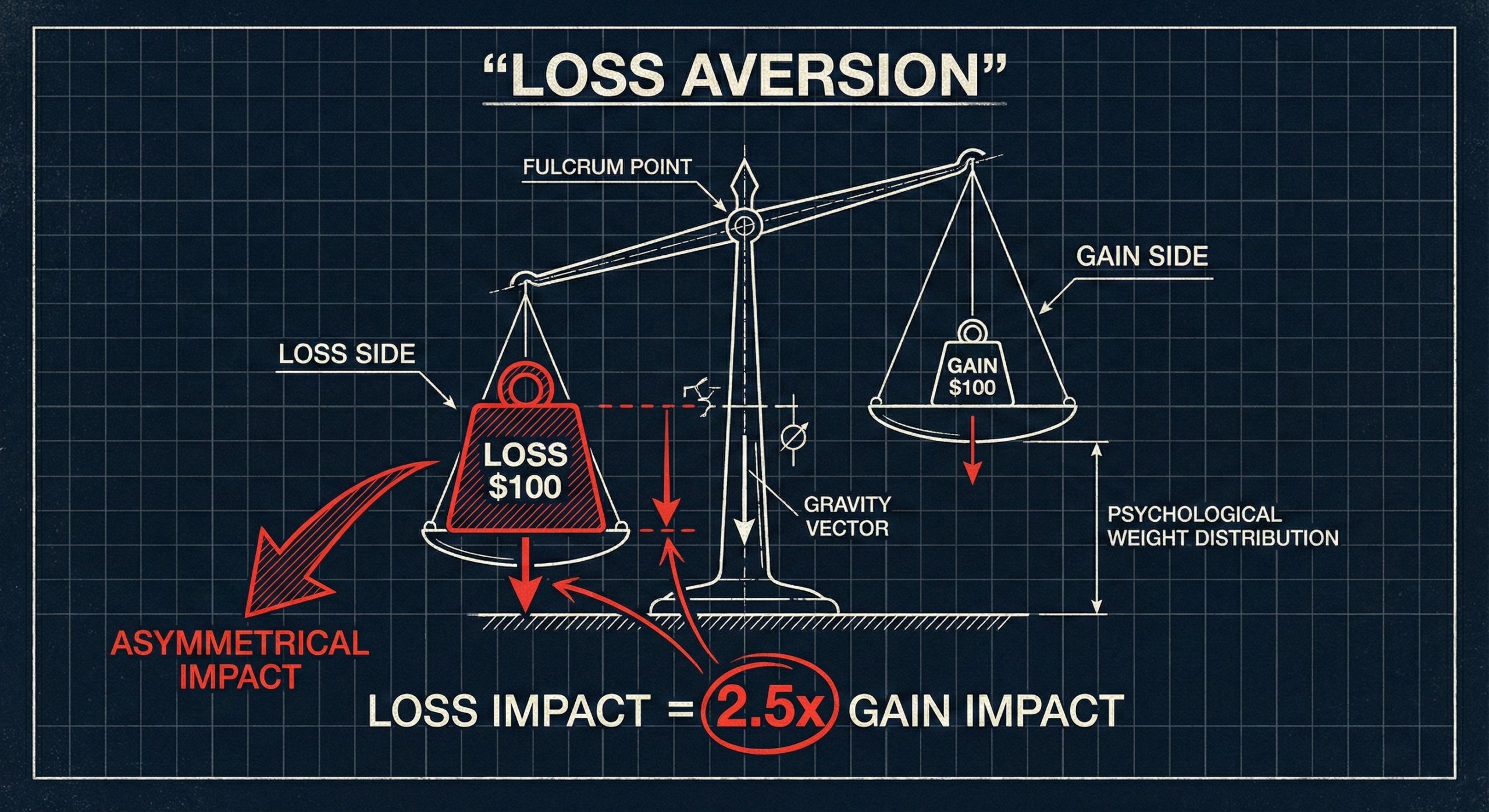
Loss Aversion: When you promise gain, they’re skeptical. When they see their own loss, they act.
Self-Persuasion: When you say it, it’s a claim. When they say it, it’s the truth.
Every psychological principle points to the same inverse proportionality.
Reduce your force. Their pursuit increases.
You pull back. They lean in.
That’s not a slogan. That’s physics.
Stop Selling. Start Diagnosing.
Persuasion is dead. The new skill is something else entirely.
Instant access. No spam. Unsubscribe anytime.